
Executive Summary
Moshannon Valley Processing Center opened in 2006 after an extended controversy around having a for-profit prison in Clearfield County. The prison closed in March 2021 and then re-opened as a detention center for immigrants, amidst a new controversy, in September 2021. The five-year contract with Immigration and Customs Enforcement is currently being considered for renewal or reconsideration.
A key part of the argument for supporters of the Moshannon Valley Processing Center (MVPC) in Clearfield County has been that it might help boost the local economy. That was the hope of local officials when MVPC opened as a privatized prison in 2006, and it continued to be the case being made as MVPC was turned into an ICE detention facility in 2021.
After two decades of experience, there is little evidence to support the promise that MVPC would spur local economic growth.
There is no doubt that opening a facility—any type of facility—entails some direct employment. There are about 300 to 400 jobs at MVPC, making it one of the bigger single employers in the area. Yet that still represents about one percent of the total jobs in the county.
The consequential question is whether the facility adds to the overall number of jobs in the community. That does not seem to be the case. The number of jobs in Clearfield County is lower today than when the facility opened, and the unemployment rate over these two decades has trended no better than in surrounding counties.
National research about the impact of prisons on local economies provides a likely explanation for the lack of job growth. Whatever jobs are created at prisons, the research shows, there is little to no impact on other local jobs, and in fact there is some evidence that there may be offsetting job losses in the rest of the private sector. There are very few positive ripple effects for local businesses, while at the same time there are negative ripple effects for businesses that may not want to be near a prison.
A prison or detention center is not all about economics, and it is important to keep in perspective that there are very real human costs of running an ICE detention center. To give just one kind of example, there have already been three deaths at MVPC since it has been running as an immigration detention center, one accompanied by a lawsuit about the circumstances.
With the contract for MVPC up for renewal or reconsideration, the lack of clear economic benefits raises very real questions about whether it is worth the cost of putting Clearfield County at the center of one of the most controversial aspects of the nation’s intensely contested immigration debates
Job Losses in Clearfield County
MVPC is frequently cited as one of Clearfield County’s largest employers. Yet the facility’s economic footprint should be understood in the context of the county’s overall labor market.
MVPC currently employs roughly 300 to 400 people,1There is no publicly available reporting of the number of people employed at the MVPC. The Moshannon Valley Economic Development Partnership said in a news report in July, 2026 that MVPC had 411 employees. See “Moshannon Valley Facility Continues to Deliver Strong Economic and Community Impact,” Gant News, July 16, 2026. The 2021 intergovernmental service agreement outlines between 266 full-time-equivalent (FTE) positions with the minimum 800 “beds,” and 316 FTE with the Tier II 1,876 “beds.” The contract is available at https://s3.documentcloud.org/documents/21177757/ice-agreement-09282021.pdf, see pp. 184ff. while average annual private employment in Clearfield County during 2024 and 2025 was roughly 29,000 workers. The facility therefore accounts for about one percent of total employment.
DECLINE IN OVERALL EMPLOYMENT IN CLEARFIELD DURING THE TIME MVPC HAS BEEN IN OPERATION

Fig. 1 Keystone Research Center and Immigration Research Initiative analysis of Quarterly Census of Employment and Wages (QCEW) data.
Unemployment Rates in the Five-County Region
If MVPC had a positive impact on the jobs picture for local residents, one of the key places we would expect to see this is in the unemployment rate.
Yet, looking at the unemployment rates of the five-county area surrounding the detention center shows that all five counties have followed the same general trajectory. Unemployment rose steeply during the Great Recession in 2008 and 2009 then gradually declined until the spike of the pandemic-era recession of 2020. Unemployment in all counties came down in the post-pandemic recovery, and have trended slightly upward since.
Clearfield County unemployment rates have been at about the middle of the pack of the five-county area from the time before the Moshannon prison opened in 2006 to when it closed as a federal prison and re-opened, a few months later, as an ICE detention center in 2021. The opening and closing of the facility show no obvious advantage to the overall employment picture.
NO DISCERNABLE IMPACT OF MVPC ON UNEMPLOYMENT TRENDS FOR CLEARFIELD
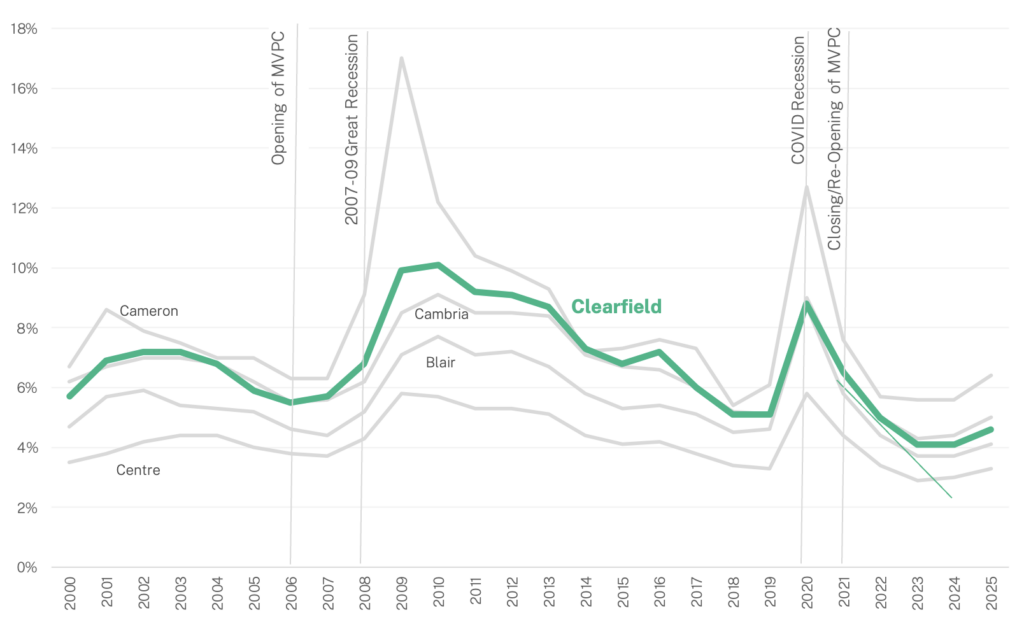
Fig 2. KRC and IRI analysis of the Bureau of Labor Statistics Local Area Unemployment Statistics (LAUS) data.
Job Growth/Decline in the Five-County Region
National research, as we will see in detail below, tells us that we should not expect a prison to have a substantial impact, either negative or positive, on the overall employment picture of a county—and that jobs gained in the prison may be offset by job declines in the rest of the private sector.
This is in line with the findings here. Clearfield County job losses are in the middle of the pack of the 5-county area. The Clearfield County employment index in 2025 is 92 percent of what it was in 2006, representing an eight percent decline in the number of jobs. Unemploymentdata cited above shows the number of people who are looking for a job but not able to find one, and it is based on a government survey. The number of jobs comes from the Quarterly Census of Employment and Wages, and is administrative data as reported by employers to the unemployment insurance system.
The first sharp decline in the number of jobs shown in the chart is seen across all five counties, and is due to the Great Recession of December 2007 to June 2009. It is, however, notable that the decline in Clearfield is the second-steepest of the five counties; MVPC does not seem to have moderated the impacts of the recession. The county that fares consistently the best here, and throughout all of these economic charts, is Centre County, home to the main campus of Penn State University, an institution that plays a very different kind of role in economic development.
CLEARFIELD: JOB LOSS COMPARED TO 2006 LEVEL
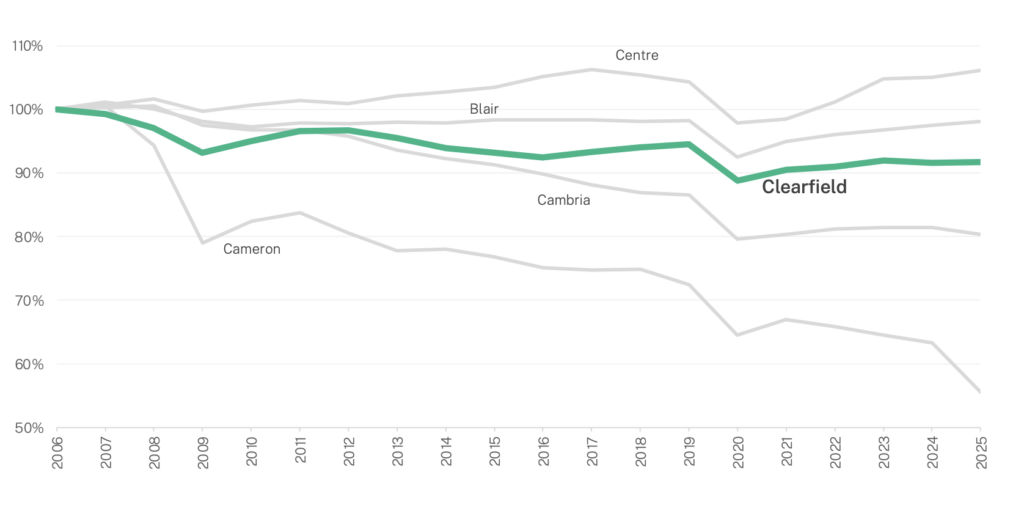
Fig 3. Trends in the number of jobs for each of the five counties, compared to their starting point in 2006, the year MVPC opened. Source: KRC and IRI analysis of QCEW data.
Trends in the Number of Employers
Measuring the number of employers is a less direct way of gauging economic outcomes than looking at employment and unemployment. The number of private-sector employers—businesses and nonprofit organizations—may change for a range of reasons. One bigger company may replace several smaller companies, for example, without the result being a decline in either employment or economic activity.
It is, nonetheless, interesting to look at the trend in the number of employers, what the QCEW measures at the level of “establishments.” Once again, Clearfield County is in the middle of the pack, showing an overall decline of 10 percent in the number of establishments, from 2,011 in 2006 to 1,819 in 2025. The number of employers is up in Blair County by four percent and up in Centre County by eight percent.3The Bureau of Labor Statistics explains: “An establishment is commonly understood as a single economic unit, such as a farm, a mine, a factory, or a store, that produces goods or services. Establishments are typically at one physical location and engaged in one, or predominantly one, type of economic activity for which a single industrial classification may be applied. An establishment is in contrast to a firm, or a company, which is a business and may consist of one or more establishments, where each establishment may participate in a different predominant economic activity.” See https://www.bls.gov/opub/hom/cew/concepts.htm.
CLEARFIELD COUNTY DECLINE IN NUMBER OF PRIVATE-SECTOR EMPLOYERS (ESTABLISHMENTS)
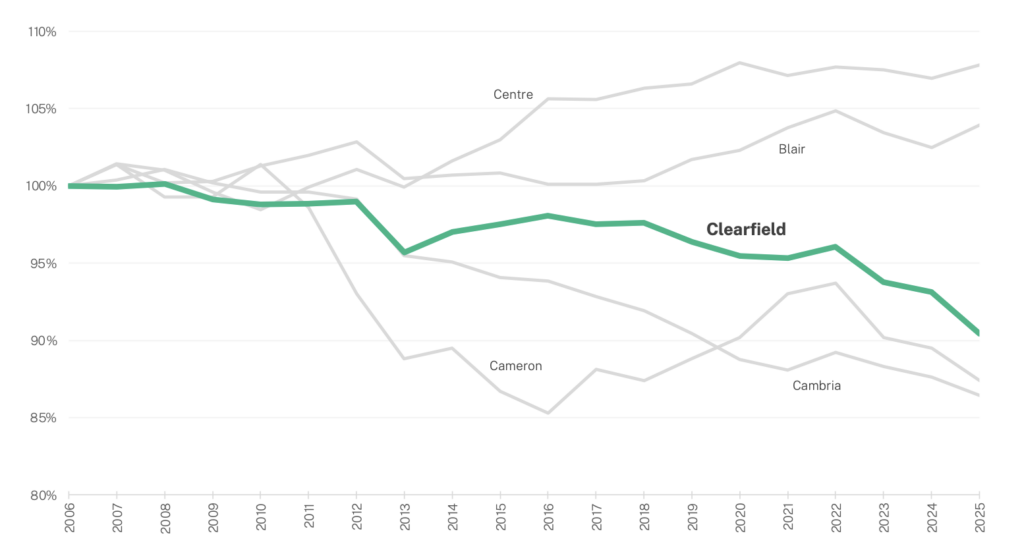
Fig 4. Trends in the number of employers—what the QCEW calls “establishments”—for each of the five counties, compared to their starting point in 2006, the year MVPC opened. Source: Keystone Research Center and IRI analysis of QCEW data.
No Multipliers: Why Detention Centers Fail to Spur Local Economic Growth
A number of factors affect the employment and unemployment rates over this time. Since MVPC is just about one percent of all employment, MVPC is hardly the only factor.
Economists typically isolate the impact of opening a prison on a local community by comparing the economic trajectories of a number of similar areas, some with and some without newly sited prisons. How do areas that added prisons fare compared to those that did not?
What academic studies have shown is:
- Prisons directly employ some people, but do not generate the hoped-for boost to overall employment.
- There is no “multiplier” effect. Hiring at the prison does not generate jobs in other industries, and may even shrink employment in other industries.
- Despite the substantial amount of public money spent on the prison, the local economic impact is typically not discernable.
- Impact on the immediately surrounding area is more negative than on the county as a whole, with prisons creating a “dead zone” for the immediate area, with decreased property values.
A 2004 study titled “Development of Last Resort” notes that prior to the 1980s, prisons were typically built in urban areas, with rural areas resisting local prison construction. But, the study reports, stresses on rural economies of the following decade pushed many small communities to turn to prisons in the hopes that they might be a lifeline for economic growth. The paper’s analysis looks at 248 towns where new state prisons were built between 1990 and 2000, and finds that “[c]ompared to other small towns roughly matched on 1990 indicators, the new state prison towns experienced substantially less growth in every economic indicator except total number of housing units and public-sector jobs,”4Terry L. Besser and Margaret M. Hanson, “Development of the Last Resort: The Impact of New State Prisons on Small Town Economies in the United States,” Journal of the Community Development Society, vol. 34, no 2, 2004. with the prison jobs typically being in the public sector.
A 2022 study looked more broadly at county-level impacts in two geographies: Texas and the United States as a whole. In both cases the study compared counties where prisons opened with those where they did not, with the Texas example allowing for a particularly strong determination of which counties could be considered comparable. The results showed no economic ripple effect—there was neither a positive nor negative impact on private-sector employment.
The way economists measure these ripple effects is through a “multiplier.” For every dollar invested, the multiplier shows how many additional dollars of economic activity are created. A multiplier of 1.5, for instance, means for every dollar invested there is $1.50 in economic activity, and a multiplier of 2 means there is $2.00 of activity. The 2022 study finds a multiplier of “approximately one.” In other words, where other sources of outside investment typically produce a positive spillover that makes local businesses grow, there is no positive spillover in the case of prisons. This study also found that property values fell in the areas nearest to the prison.5Chirakijja, J. (2022). “The Local Economic Impacts of Prisons.” The Review of Economics and Statistics, 1–45.
Finally, a 2024 study showed even less encouraging results. Looking at counties across the United States over the four-decade period from 1960 to 2000, the study found that jobs added in a prison seem to be offset by job loss in the broader private sector. The analysis showed that when a prison opened there were, of course, jobs in the prison. But, the prison in turn had a negative impact on private-sector employment. Counties with prisons were associated with decreased employment in manufacturing, finance and the recreational services sectors.6Yiwen Zhang, “Did the Prison Industrial Complex Deliver on Its Promise? Prison Proliferation and Employment in Rural America,” The British Journal of Criminology, Volume 64, Issue 1, January 2024, Pages 229–247.
These studies do not look at budget impacts on local governments, but there can also be costs to the county associated with emergency medical care, wastewater treatment, or investigation of assaults or deaths inside the facility.
The Human Toll of MVPC
While this report is focused on the unfulfilled economic promise of MVPC, the economic question should not overshadow the human cost of immigration detention.
One very visible aspect of the cost is deaths at the facility. ICE has reported three horrifying deaths since MVPC opened as a detention facility in 2021. Chaofeng Ge, a Chinese immigrant, was found dead with his hands and feet tied. While the county coroner ruled his death as a suicide, his family is suing to obtain records that may explain the circumstances of his death. Frankline Okpu was found unresponsive in his cell following an overdose. And Fouad Saeed Abdulkadir suffered from complex mental health needs, asthma, and chronic pain. For weeks he reported chest pain and numbness before he died in Moshannon from “medical distress.”
Despite MVPC’s walls and razor-wire fence, the facility does not operate on in isolation. The families and friends of these individuals will be forever haunted by images of their loved ones in danger and distress in immigration detention. These discoveries can also have a traumatic impact on the facility guards or nurses.
- 1There is no publicly available reporting of the number of people employed at the MVPC. The Moshannon Valley Economic Development Partnership said in a news report in July, 2026 that MVPC had 411 employees. See “Moshannon Valley Facility Continues to Deliver Strong Economic and Community Impact,” Gant News, July 16, 2026. The 2021 intergovernmental service agreement outlines between 266 full-time-equivalent (FTE) positions with the minimum 800 “beds,” and 316 FTE with the Tier II 1,876 “beds.” The contract is available at https://s3.documentcloud.org/documents/21177757/ice-agreement-09282021.pdf, see pp. 184ff. ↩︎
- 2This is data from the U.S. Bureau of Labor Statistics’ Quarterly Survey of Employment and Wages. It is the most precise source of local employment data. ↩︎
- 3The Bureau of Labor Statistics explains: “An establishment is commonly understood as a single economic unit, such as a farm, a mine, a factory, or a store, that produces goods or services. Establishments are typically at one physical location and engaged in one, or predominantly one, type of economic activity for which a single industrial classification may be applied. An establishment is in contrast to a firm, or a company, which is a business and may consist of one or more establishments, where each establishment may participate in a different predominant economic activity.” See https://www.bls.gov/opub/hom/cew/concepts.htm. ↩︎
- 4Terry L. Besser and Margaret M. Hanson, “Development of the Last Resort: The Impact of New State Prisons on Small Town Economies in the United States,” Journal of the Community Development Society, vol. 34, no 2, 2004. ↩︎
- 5Chirakijja, J. (2022). “The Local Economic Impacts of Prisons.” The Review of Economics and Statistics, 1–45. ↩︎
- 6Yiwen Zhang, “Did the Prison Industrial Complex Deliver on Its Promise? Prison Proliferation and Employment in Rural America,” The British Journal of Criminology, Volume 64, Issue 1, January 2024, Pages 229–247. ↩︎