When ICE and other federal enforcement agents stormed into Minnesota, Oregon, Illinois, and Washington DC, among other areas, residents and local officials expressed outrage and resisted the incursion and dramatic disruption of their communities.
There are far-reaching social and humanitarian implications to the current administration’s extreme enforcement regime, as well as constitutional questions about the conduct of federal and local law enforcement agencies. But there is also an economic risk that can be quantified.
The economic risks of increased immigration enforcement and mass deportations, include:
- Potential risks to occupations with a large percentage of immigrant workers, such as construction laborers, doctors, maids, and nurses;
- Job losses for US-born workers in roles that are adjacent to immigrant workers, such as in restaurants or hotels;
- Challenges for families that rely on immigrants for childcare or as home health aides;
- A loss in federal, state and local tax revenue paid by immigrants who are undocumented. If ten percent of people who are undocumented are detained or deported, the loss would be $9.7 billion.1David Dyssegaard Kallick, “People Who Are Undocumented: Occupations, Taxes Paid, and Long-Term Economic Benefits,” Immigration Research Initiative, July 29, 2024, based on data from the Institute on Taxation and Economic Policy. Carl Davis, Marco Guzman, and Emma Sifre, “ ,” Institute on Taxation and Economic Policy, July 30, 2024. And National Deficit data, United States Treasury Department, “What is the deficit”
- Deporting large communities of immigrants will shrink the US economy for everyone.
Both immigrants who are undocumented and those with legal status are at risk for deportation
Of the 50 million immigrants who live in the United States, 24 million people are non-citizens. An estimated 14 million immigrants in the United States were undocumented.2The total population, number of immigrants, and number of non-citizens is drawn from an Immigration Research Initiative analysis of the 2024 American Community Survey, one-year data, the most recent detailed data available. The estimate of immigrants who are undocumented is shown in the Immigration Research Initiative fact sheet, “50 States: Immigrants by Number and Share.” The three leading sources of estimates of people who are undocumented are shown there, from the Pew Research Center, the Center for Migration Studies, and the Migration Policy Institute; all three use 2023 data for their most recent estimates.
The immigrants most vulnerable to deportation are those who lack legal papers, but the harm does not end there. The administration is stripping work permits and temporary status from people who have been here with permission, effectively “de-documenting” them. This includes people with Temporary Protected Status, those officially seeking asylum, young people with Deferred Action for Childhood arrivals, and more. The administration is revoking the citizenship immigrants who have become naturalized citizens, and says it aims to de-naturalize 100 to 200 citizens per month.3Hamed Aleaziz, “Trump Administration Aims to Strip More Foreign-Born Americans of Citizenship” New York Times, December 17, 2025. Free speech for immigrants has also been revoked: student visa holders and legal permanent residents have been targeted for deportation based on political speech and activities.4Tara Watson and Jonathan Zars, “100 days of immigration under the second Trump administration,” Brookings Institution, April 29, 2025.
Mass deportations pose broad risks for the US economy
Immigrants are integral to everyday life in the United States. Putting immigrants at risk of unregulated enforcement will cause predictable harm to communities across the state.
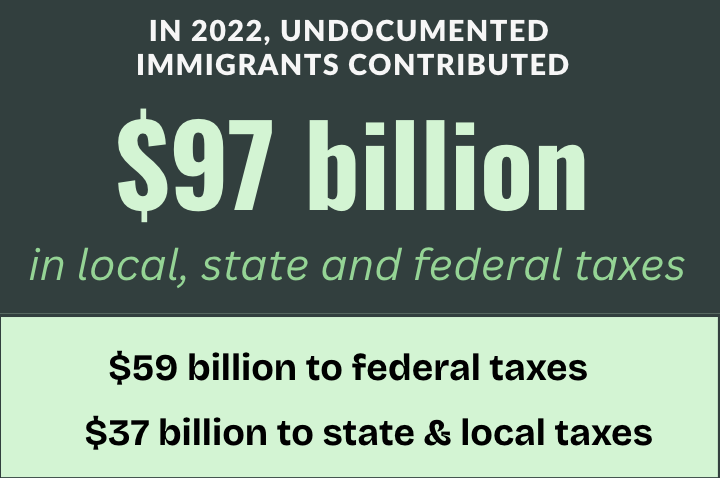
Mass deportations would affect economic output, tax revenues, and business activities in the United States. Immigrant workers, both documented and undocumented, accounted for 19 percent of GDP in the United States in 2024.5Immigrant share of economic output is estimated by showing the share of all earned income – wages plus proprietors’ earnings. The data source is the 2024 American Community Survey, one-year data. More than 1 out of every 5 business owners are immigrants.6David Dyssegaard Kallic, Dr. Anthony Capote, Steve Tobocman, Chanell Scott Contreas, Dr. Alaina Jackson, “The Entrepreneurial Spirit: A Profile of Business Owners Across the United States”, March 2026, Immigration Research Initiative, E Pluribus and Build from Within Alliance. Immigrants make up 22 percent of all business owners in the US in 2024, a higher share of the population ( 15 percent) or the labor force (18 percent).7 IRI Analysis of 2024 American Community Survey, one-year data. These businesses help maintain the vibrancy of America’s economy by spurring innovation, hiring workers, and adding locally owned storefront shops that keep neighborhoods vibrant. And while all immigrants pay taxes, immigrants who are undocumented alone contribute $96.7 billion in U.S. taxes, including $59.4 billion in payments to the federal government and $37.3 billion in state and local taxes, which help pay for the vital programs and services that everyone relies on.8See David Dyssegaard Kallick, “People Who Are Undocumented: Occupations, Taxes Paid, and Long-Term Economic Benefits,” cited above.
In the United States overall, a recent report by the Cato Institute9David J. Bier, Michael Howard, and Julián Salazar,Immigrants’ Recent Effects on Government Budgets: 1994–2023, Cato Institute, February 3, 2026.looked in great detail at the overall impact immigrants have on government budgets and found that immigrants pay more in taxes than they generate in added costs for services. Over the past 30 years immigrants generated a cumulative $10.6 trillion more in taxes than they received in benefits at all levels of government—federal, state and local, and reduced the federal deficit by a total of $14.5 trillion. Non-citizens generated more in taxes than in added services, and so did immigrants who are undocumented. And the children of immigrants, the second generation, are even more fiscally positive. The fact that immigrants are more likely to be in prime working age is a key driver of these findings, as is the fact that immigrants are less likely to receive public benefits.10Economic and Fiscal Impact of Immigration, National Academies of Sciences, Engineering, and Medicine, The Economic and Fiscal Consequences of Immigration (National Academies Press, 2017).
Childcare, health care, hospitality, and other critical jobs are at risk from mass deportations11The industry and occupations data in this section were drawn from an Immigration Research Initiative analysis of the 2024 American Community Survey, one-year data, the most recent detailed data available.
While physicians and registered nurses may not be at high risk of deportation, limits and termination of H1B visas are likely to affect at least some health care professionals. Anyone concerned that ICE agents may think they “look like” an immigrant may understandably be concerned, and some doctors and health professionals have been deported because of political opinions they expressed.
Restaurants: Immigrants make up 19 percent of all workers in the leisure and hospitality industry. Immigrants play a particularly big role in restaurants. There are 640,000 cooks who are immigrants (26 percent of the total), an additional 190,000 chefs/head cooks (36 percent of the total), and 85,000 dishwashers (23 percent of the total).
Personal, home, and office: In the United States, immigrants who are at risk of deportation are playing an important, if often not so visible, role in a range of occupations that touch our everyday life. There are 750,000 janitors (28 percent of the total) who are immigrants, 4400,000 landscaping workers (32 percent of the total), 220,000 nail technicians (74 percent), 58,000 dry cleaning and laundry workers (38 percent), and 706,000 maids and housekeepers working in homes as well as hotels and other workplaces (49 percent of the total).
Construction: Nationally, 3 million people who are immigrants work in the construction industry, making up 1 out of every 4 four construction workers (25 percent of the total). Looking at detailed occupations across all industries, there are 840,000 construction laborers who are immigrants (39 percent of the total), 410,000 carpenters (30 percent), 282,000 painters12The occupation “painters” also includes paperhangers. (44 percent), and 110,000 roofers (48 percent).
Farming: Over half of all crop workers in the United States are immigrants, and the vast majority of the immigrants are either undocumented or seasonal H-2A workers, both categories of immigrants that have been threatened by the Trump administration.13Gutiérrez-Li, Alejandro. “Feeding America: How Immigrants Sustain US Agriculture,” Baker Institute for Public Policy, July 19, 2024. https://www.bakerinstitute.org/research/feeding-america-how-immigrants-sustain-us-agriculture Pay and working conditions are in dire need of improvement for farm workers. But the likely result of deporting current immigrants and restricting new immigration is not an improvement of working conditions, but a decline in farming.
Deporting Immigrants Shrinks the Economy…for Everyone
When large numbers of workers are deported, the economy gets smaller. The most direct impact is on immigrants and their families, but there is a clear impact on the businesses immigrants work for, the people they work next to, and the communities they live in. Leading economic research shows that, contrary to popular belief, deporting immigrants reduces the number of jobs for other workers.14East, et al. “The Labor Market Effects of Immigration Enforcement,” Journal of Labor Economics, vol 41, number 4. This work is summarized in an accessible fashion by Chloe N. East in “The Labor Market Impact of Deportations” The Hamilton Project, Sept. 18, 2024.
If construction companies experience a shortage of roofers or construction laborers (where immigrants are particularly concentrated), for example, they cannot take on as many projects, reducing jobs for electricians and construction managers (where U.S.-born workers may find jobs). If there is a shortage of dishwashers or bus staff, others in the restaurant industry may be pushed downward into these jobs. And, when there are fewer immigrants, that also means fewer customers for local businesses. The impact is even more severe when taking into account the brutal disruptions caused by massive immigration enforcement.
If hundreds of thousands of workers are removed from food service, care work, or construction, you don’t just disrupt those families — you destabilize the systems our communities rely on every single day. For more detail, and for state-specific information, please refer to our roundup of state reports here: The Economic and Fiscal Impacts of Mass Deportation: What’s at Risk in your State?
- 1David Dyssegaard Kallick, “People Who Are Undocumented: Occupations, Taxes Paid, and Long-Term Economic Benefits,” Immigration Research Initiative, July 29, 2024, based on data from the Institute on Taxation and Economic Policy. Carl Davis, Marco Guzman, and Emma Sifre, “ ,” Institute on Taxation and Economic Policy, July 30, 2024. And National Deficit data, United States Treasury Department, “What is the deficit” ↩︎
- 2The total population, number of immigrants, and number of non-citizens is drawn from an Immigration Research Initiative analysis of the 2024 American Community Survey, one-year data, the most recent detailed data available. The estimate of immigrants who are undocumented is shown in the Immigration Research Initiative fact sheet, “50 States: Immigrants by Number and Share.” The three leading sources of estimates of people who are undocumented are shown there, from the Pew Research Center, the Center for Migration Studies, and the Migration Policy Institute; all three use 2023 data for their most recent estimates. ↩︎
- 3Hamed Aleaziz, “Trump Administration Aims to Strip More Foreign-Born Americans of Citizenship” New York Times, December 17, 2025. ↩︎
- 4Tara Watson and Jonathan Zars, “100 days of immigration under the second Trump administration,” Brookings Institution, April 29, 2025. ↩︎
- 5Immigrant share of economic output is estimated by showing the share of all earned income – wages plus proprietors’ earnings. The data source is the 2024 American Community Survey, one-year data. ↩︎
- 6David Dyssegaard Kallic, Dr. Anthony Capote, Steve Tobocman, Chanell Scott Contreas, Dr. Alaina Jackson, “The Entrepreneurial Spirit: A Profile of Business Owners Across the United States”, March 2026, Immigration Research Initiative, E Pluribus and Build from Within Alliance. ↩︎
- 7IRI Analysis of 2024 American Community Survey, one-year data. ↩︎
- 8See David Dyssegaard Kallick, “People Who Are Undocumented: Occupations, Taxes Paid, and Long-Term Economic Benefits,” cited above. ↩︎
- 9David J. Bier, Michael Howard, and Julián Salazar,Immigrants’ Recent Effects on Government Budgets: 1994–2023, Cato Institute, February 3, 2026. ↩︎
- 10Economic and Fiscal Impact of Immigration, National Academies of Sciences, Engineering, and Medicine, The Economic and Fiscal Consequences of Immigration (National Academies Press, 2017). ↩︎
- 11The industry and occupations data in this section were drawn from an Immigration Research Initiative analysis of the 2024 American Community Survey, one-year data, the most recent detailed data available. ↩︎
- 12The occupation “painters” also includes paperhangers. ↩︎
- 13Gutiérrez-Li, Alejandro. “Feeding America: How Immigrants Sustain US Agriculture,” Baker Institute for Public Policy, July 19, 2024. https://www.bakerinstitute.org/research/feeding-america-how-immigrants-sustain-us-agriculture ↩︎
- 14East, et al. “The Labor Market Effects of Immigration Enforcement,” Journal of Labor Economics, vol 41, number 4. This work is summarized in an accessible fashion by Chloe N. East in “The Labor Market Impact of Deportations” The Hamilton Project, Sept. 18, 2024. ↩︎