Immigrants Add to the Vibrancy of Minneapolis
All around the country people are focused on Minneapolis. Militarized and masked federal agents are sweeping refugees—who are lawfully present—into planes to be sent to Texas for “re-interviews,” journalistsand protesters are being pepper sprayed at close range, and the national news has been rivetted on horrifying videos of Rene Nicole Good and Alex Pretti being shot and killed by ICE agents.
What’s at stake is much more than just immigration policy. But the pretext for federal agents to be in Minneapolis is a fabricated notion that there is an immigration crisis. That’s far from the reality.
An upcoming joint report from Immigration Research Initiative, developed with the Build from Within Alliance and Global Detroit’s E Pluribus project, gives one snapshot that tells the story of vibrant immigrant communities contributing to the local economy and daily life.
There are 9,000 immigrant business owners in the Minneapolis metro area, making up 12% of all business owners in the region. In the twin cities metro area, 550 restaurant owners are immigrants, and overall there are 2,000 “Main Street” business owners, amounting to 15% of all Main Street businesses in the region.
“Main Street” businesses are the independently owned restaurants, grocery stores, clothes stores, and nail salons that give neighborhoods and commercial corridors their character and often play a critical role in a neighborhood’s vibrancy and economic revitalization. Even better is when these types of businesses are supported by local economic development efforts, such as the Midtown Global Market in Minneapolis.
See methodology (below) for details, and a report on Main Street business owners here.
Immigrants Add to the Vibrancy of the Minneapolis-St. Paul Metro Area
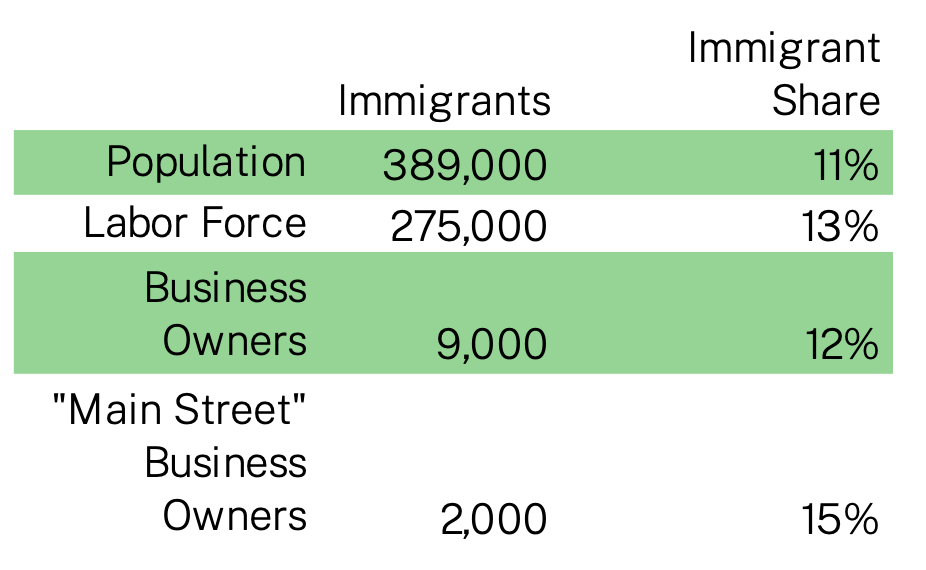
Source: Immigration Research Initiative calculations based on 2023 American Community Survey 5-year data.
Nationally, while immigrants comprise 14% of the U.S. population and 18% of the labor force, 22% of all business owners are immigrants, as are 27% of all Main Street business owners.
Methodology
Business owners are defined as people who are self-employed, and own their own incorporated business.
“Main Street” business owners are people who own businesses in three broad sectors: Retail (from jewelry stores to florists to grocery stores), Accommodation and Food Services (restaurants, bars and hotels), and Neighborhood Services (beauty salons, barber shots, nail salons, dry cleaning, and car washes). The first two are standard industry categories, while the third is the majority of what is generally called “Other Services.”