
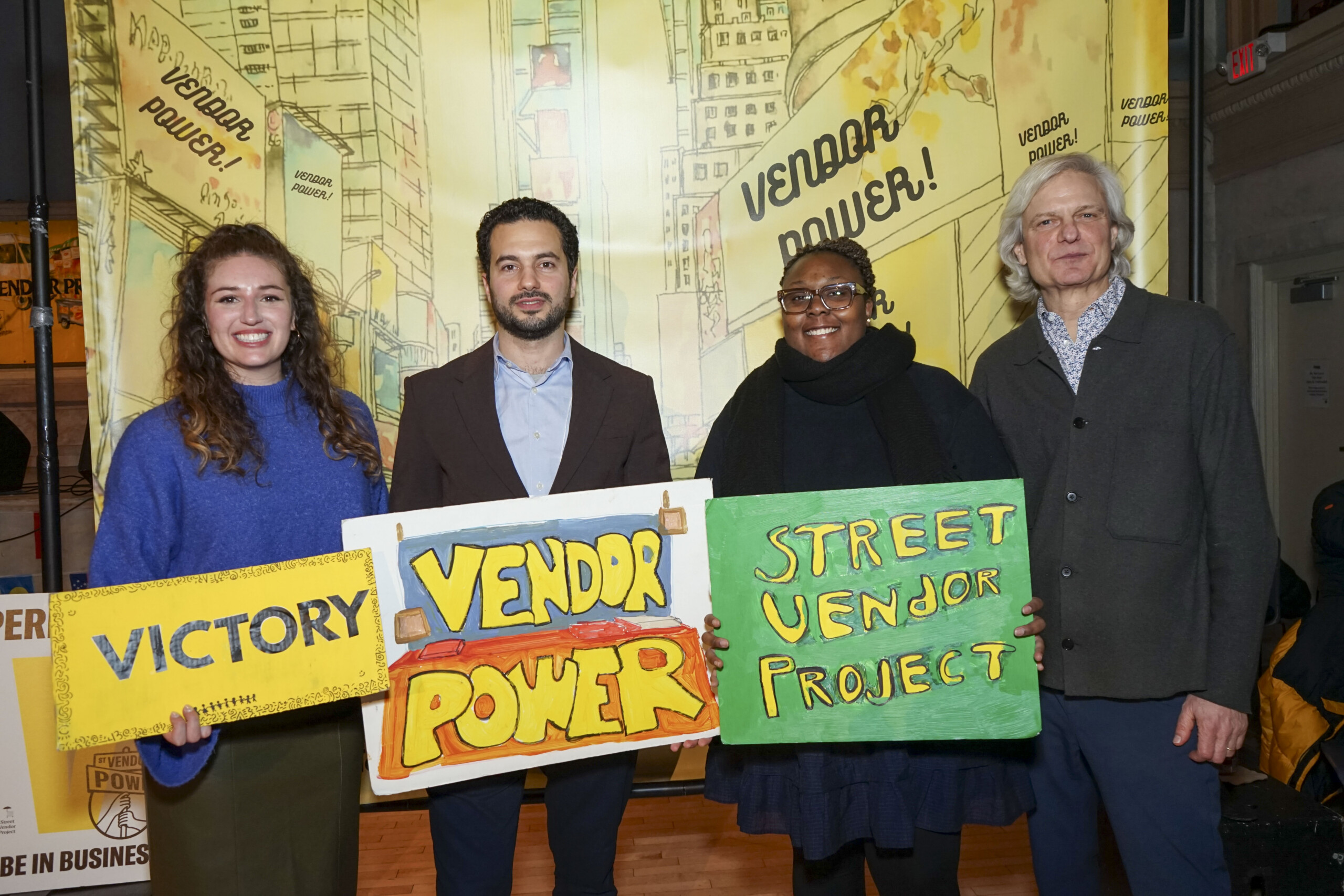
For decades, unsustainably low caps on city-issued licenses and permits meant endless problems for street vendors in New York City. That all changed in January 2026, when the Street Vendor Project convinced NYC City Council to pass a suite of bills that correct the situation.
Aminata Volta, who received her general vendor license in January after almost a decade on the waitlist said, “I almost fainted. I called everybody to tell them about it.” Like the vast majority of vendors, Volta is an immigrant; she arrived from Burkina Faso in 1987 and sells handmade jewelry and accessories in Harlem. The power of this moment is reflected through the impact that this will have on the lives of tens of thousands of New Yorkers who have waited years for permits. Volta enthused, “I can’t wait for the other vendors to get their permits. The joy — I want them to feel the same joy.”
Street vendors are New York’s smallest business owners. They are entrepreneurs who provide affordable, convenient, and familiar food and goods to their customers, and their presence energizes the streetscape in neighborhoods across all five boroughs. At IRI, we are thrilled to celebrate the years of hard work and advocacy led by the Street Vendor Project.
It took a supermajority of NYC councilmembers in January to pass the package of bills over the late December veto of former Mayor Eric Adams. These new laws will significantly raise the cap on street vendor permits and create an office of Street Vendors within the Department of Consumer Affairs/Small Businesses to help educate and support street vendors.
The package of bills represents a historic breakthrough: no new street vending licenses have been issued in New York City since 1979. The new legislation expands the number of general merchandise licenses available to 10,500 by 2027 and includes 11,000 mobile food vending licenses over the next 5 years, expanding the number of vendors able to operate legally across the city. In doing so, it will support the families’ vendors provide for, the children they care for, and the careers they have worked hard to build. The new laws also establish an Office of Street Vendor Services, providing long overdue enforcement coordination, education, and support.
IRI’s 2024 report, Street Vendors of New York, provided empirically grounded data that helped in the advocacy efforts by painting a clearer picture of who street vendors are and how they live and work. Prior to this study, little was known about this group of entrepreneurs who are a visible yet often misunderstood part of the city’s economy. This research helped document the realities of street vending and the essential role vendors play in New York City life.
Our findings show that approximately 23,000 street vendors operate across New York City’s five boroughs. The vast majority, 96 percent, are immigrants, and nearly 81 percent rely on vending as their primary source of income.These are demanding jobs, often performed outdoors, with far less security than work afforded to those employed indoors. These challenges have only intensified in recent years. Protecting and supporting street vendors means standing up for a workforce that is a staple of New York City’s economy, culture, and daily life.
Carina Kaufman-Gutierrez, Deputy Director of the Street Vendor Project at the Urban Justice Center, explained why the data matters. Having an empirically grounded analysis, she said,“illuminated the critical gap in services and licensing to existing street vendors, and became the seminal study on street vending used to form the Street Vendor Reform Package.”