The Unforeseen Fiscal Cost of Verifying Student Immigration Status
Two bills currently before the Tennessee legislature would restrict the access of many immigrant children to K-12 education. Both bills have significant moral and human costs. Both face legal and constitutional hurdles. And both challenge the notion that all Tennessee children should have access to free public education from kindergarten through high school.
In addition to moral and human considerations, however, there are also administrative costs to each school district that have been brushed aside but that will not be trivial. Requiring that all students prove their citizenship or immigration status requires parents to assemble and show birth certificates, passports, green cards, or other documents that can prove a child’s status. It would require school officials to be trained in how to evaluate this wide range of documents.
This state legislation would also create administrative costs for each local school district that have not been openly foreseen. HB 1711/SB 2108 and HB 793/SB 836 both would require students to “show their papers.” Both would have a powerful chilling effect that would result in many immigrant children missing out on a basic education. The bills would also create a significant hurdle for many children who are not immigrants, but whose parents may not have the necessary documents at hand.
The legislation would require local districts to gather, evaluate, and store citizenship and immigration records for very large numbers of children. H.B. 1711/SB 2108 would require school officials to evaluate the citizenship or immigration status of all 963,000 students in the Tennessee school system upon going into effect. HB 793/SB 836 would require doing so for all enrolling students, which presumably would mean those newly in a school.
IRI estimates that verifying the status of all students in the state would entail hiring, training and equipping 934 school personnel. For context, that is roughly half the number of school nurses in Tennessee public schools.1 Annual School Health Services Report, 2023-2024 School Year, Tennessee Department of Education. Figure 2 shows 1,852 full-time equivalent (FTE) nurses working in Tennessee public school districts. IRI estimates that the cost of hiring these 934 employees would total roughly $55 million statewide.
The cost of evaluating the status of only newly enrolling students would be lower. Verifying every 5-year-old coming to school for the first time the cost would cost roughly $4 million statewide (1/13th of the total), and the cost of including all newly enrolling students could well be double or triple that amount, since students move into and out of districts at every grade level.
Calculated here are the costs for the first year of potential implementation. These are not one-time costs. The expense for each district would be highest in the first year of implementation but would continue to recur every school year.
Finally, there are also very significant long-term costs to the Tennessee economy if significant numbers of children are kept out of school. This analysis focuses just on the narrow question of administrative costs for the bills, not on the overall economic consequences for the state.
Administrative Costs to School Districts Across Tennessee
In the 2024-2025 school year, there were 969,000 students in the state’s public school system.2From Tennessee Public School data available online at Tennessee e Department of Education. These students are spread out across 149 school districts, ranging in size from 106,000 students in Memphis-Shelby County Schools to fewer than 200 students in Richard City.
To evaluate the status of all students in the state would require the school system to establish an accurate accounting of the immigration status for all 969,000 students in Tennessee’s public school system. Evaluating the status of only newly enrolling students would still be a significant burden. Either approach is a remarkably large and complex task that requires millions of taxpayer dollars that could be used for other much-needed purposes.
The burden will not fall only on immigrants. Many students who were born in the Unted States may not have documents verifying their citizenship status. Among those most likely to have difficulty locating documents are students born outside of hospitals, unhoused students, survivors of domestic violence or natural disasters, and students whose families have very low incomes. A report from the Center for Law and Social Policy (CLASP) suggests that a substantial number of students in Tennessee might fall into one or more of these categories. For instance, 31 percent of Tennessee students were found to be economically disadvantaged, a number that includes students who are homeless, runaways, or part of the foster care system.3“Adverse Consequences of Increased Administrative Burden on All K-12 Students,” Center for Law and Social Policy, March 10, 2025. In a related analysis looking at adults, the Brennan Center for Justice found that 21 million citizens of voting age nationwide do not have ready access to papers that prove their citizenship.4Kevin Morris and Cora Henry, Millions of Americans Don’t Have Documents Proving Their Citizenship Readily Available, Brennan Center for Justice, June 11, 2024. Children and their parents can be expected to have as much of a hard time finding appropriate documentation as voting-age adults.
STATEWIDE ESTIMATE FOR VERIFYING STATUS OF ALL STUDENTS, AND JUST INCOMING 5-YEAR OLDS
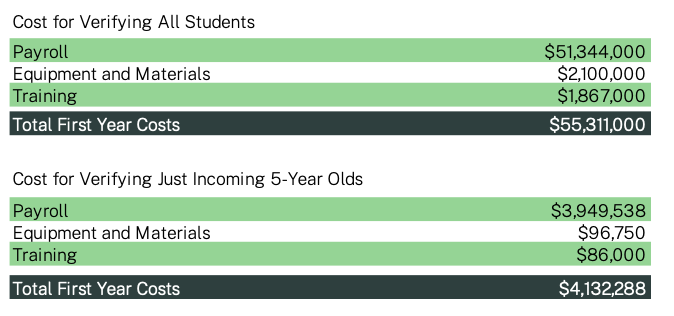
Fig 1. A low-end estimate of the cost of verifying status of newly enrolling students is obtained by dividing the total of all students by 13 to get a rough estimate of the number of kindergarten students each year. There are also students who move into (and out of) the district in all grades, so this can be considered a low figure and the number of enrolling students might well be two or three times times this number.
An analysis of Metro Nashville Public Schools in 20255IRI’s cost analysis is based on an internal study conducted by Metro Nashville Public Schools in 2025, which estimated the cost of verifying legal status for Nashville’s 78,000 public school students. The analysis estimated that each administrator could process 1,038 students per year. It assumed people would be hired at the starting wage for District Enrollment Assistants in the district of $21.40 per hour or $44,000 annually, and added roughly 30 percent for benefits and Social Security, Medicare, and unemployment insurance taxes, bringing the total cost per employee to about $55,000. estimated that it would take 77 full-time employees one year to validate the 78,000 students in that district, making each employee responsible for 1,038 students. Scaling that out across the whole state, IRI calculates that it would take 934 full-time employees to validate the immigration status of every single student in Tennessee public schools over the course of a full calendar year. That is, the state would have to recruit, equip, train, and pay 934 people to evaluate 1,038 students each to cover the 969,000 students in Tennessee schools.
To consider the cost, IRI’s estimate follows the Nashville example and considers an average wage of $44,000 per year and total personnel cost (including taxes and benefits) of $55,000, resulting in $51 million in payroll costs. Each of these new employees would have to be equipped with desks, computers, software licenses and other materials, which estimated at $2,250 per employee. There would also be training required, which is estimated at $2,000 per employee. Equipment and training for 934 new employees is estimated to come to $2.1 million for supplies and $1.9 million in training costs.
All told, IRI estimates that evaluating the status of all students in the state would cost Tennessee taxpayers roughly $55 million in its first year alone.
Evaluating the status of newly enrolling students would require setting up many of the same processes for training and hiring, but the number of students being evaluated would be smaller. We do not have a good basis for estimating how many children are new to the schools each year, but we can assume it is at a bare minimum the number of new kindergarten students. As noted above, verifying every 5-year-old coming to school for the first time would be roughly $4 million, and the number of new students, and therefore the cost, could be double or triple that amount when accounting for people newly moving into the schools at other grade levels. And, these are just the first-year costs. Recurring costs for evaluating incoming students would be roughly the same every year, and costs for evaluating all students would be lower after the first year.
Verifying status would be an untested new undertaking, so there are several variables that could make the cost higher or lower. The assumed salary of $44,000 (and total personnel cost of $55,000 including taxes and benefits) might be higher or lower in different districts. It is hard to know whether a single employee can process 1,038 students, and in what time period—again, the figure could be higher or lower. And, with HB 793/SB 836, it is not clear how many students would need to be enrolled each year and how many would already be processed. Additionally, IRI assumes here that districts can manage to hire staff readily on a part-time basis where needed, and we allocate training and equipment costs proportionately, though it may not be straightforward to find and train staff in this way.
COST TO SCHOOL DISTRICTS ACROSS TENNESSEE

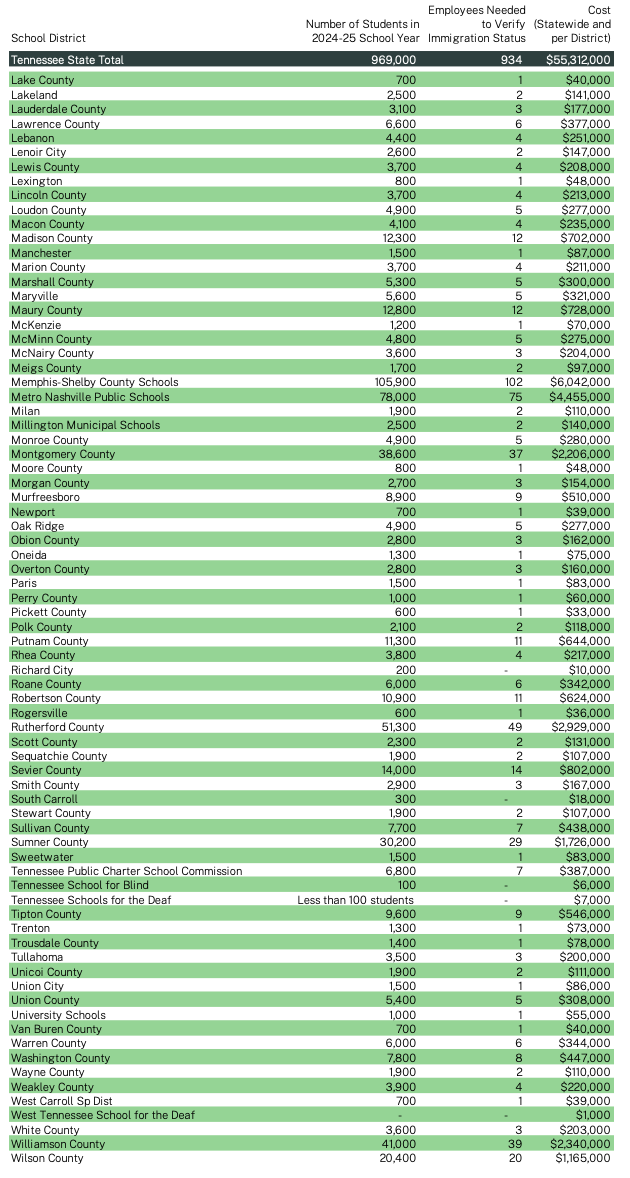
Fig 2. Numbers are independently rounded and columns may not sum to total. Costs might be higher or lower in individual districts; see text for details. Costs related to verifying only newly enrolling students rather than all students would be lower, though not necessarily proportionately lower.
- 1Annual School Health Services Report, 2023-2024 School Year, Tennessee Department of Education. Figure 2 shows 1,852 full-time equivalent (FTE) nurses working in Tennessee public school districts.
- 2From Tennessee Public School data available online at Tennessee e Department of Education.
- 3“Adverse Consequences of Increased Administrative Burden on All K-12 Students,” Center for Law and Social Policy, March 10, 2025.
- 4Kevin Morris and Cora Henry, Millions of Americans Don’t Have Documents Proving Their Citizenship Readily Available, Brennan Center for Justice, June 11, 2024.
- 5IRI’s cost analysis is based on an internal study conducted by Metro Nashville Public Schools in 2025, which estimated the cost of verifying legal status for Nashville’s 78,000 public school students. The analysis estimated that each administrator could process 1,038 students per year. It assumed people would be hired at the starting wage for District Enrollment Assistants in the district of $21.40 per hour or $44,000 annually, and added roughly 30 percent for benefits and Social Security, Medicare, and unemployment insurance taxes, bringing the total cost per employee to about $55,000.