
A Report of Immigration Research Initiative, National Immigration Law Center, and Regional Planners
Since taking office, the Trump Administration has been working to vastly expand the already enormous U.S. immigration detention system. Under former DHS Secretary Kristi Noem, Immigration and Customs Enforcement (ICE) launched its “Detention Reengineering Initiative”—a plan that would put tens of billions of taxpayer dollars into buying and converting warehouses and other facilities across the country into detention centers to jail immigrants on a mass scale for indefinite periods. Across the country, including in many Republican-dominated areas, people have recognized the dehumanizing impact of warehousing people and opposed it.
The status of the administration’s detention expansion plans appears to be in flux following Noem’s firing. Recent reports suggest the administration is attempting to sell back several of the eleven facilities it has already purchased. Critically, however, the administration still intends to move forward with converting four of the purchased warehouses for immigration detention: in San Antonio and Socorro, Texas; Surprise, Arizona; and Hagerstown, MD, according to a New York Times report. Warehouses that the government doesn’t or can’t sell back may be offloaded to other federal agencies.
These four sites will cause extensive harm in and of themselves, and who knows how many more may be in the pipeline over the coming years. We fear these sites could serve as a blueprint for future use in other facilities by this or future administrations. ICE’s goal still seems to be to have the capacity to jail 92,600 people on any given day, and to deport 1 million people per year.
In the areas where ICE has already bought warehouses as well as those where it still may be in question, residents and local governments may feel pressured to accommodate ICE’s detention plans because of a misguided belief that this is their only option for dealing with warehouses that are eyesores. Nothing could be further from the truth. Many of the past and current sites are in locations where they can find synergies with other nearby activities or create new connections in nearby communities. Alternative uses—from libraries to office parks—would spark local economic growth. Meanwhile, an immigration jail will predictably create an economic dead zone.
Detention Centers Bring Many Problems, While Alternatives Can Be Exciting
For municipalities that feel desperate to see any use, even a detention center, in place of a vacant warehouse, it’s important to know that there are alternatives. Structurally, a warehouse is a simple, giant box with tall ceilings, unencumbered by columns or supporting walls, heavy load-bearing floors, and ready access for large-scale operations. This makes warehouses easily adaptable for alternative uses. In fact, they are terrific for a wide range of uses, except for warehousing people. The re-use can be strictly functional or feature impressively high-quality design.
FORMERLY A BIG BOX STORE—NOW A LIBRARY IN MCALLEN, TEXAS

Image credit: MSRDesign, Lara Swimmer.
Libraries. Public schools or neighborhoods are near some of the warehouse sites. This makes those sites particularly ill-suited to housing thousands of people behind bars. They could be great places, however, for a library, as is the new use of a former Walmart in McAllen, Texas.
Educational Centers. Big-box stores and warehouses can be reborn as added community educational centers. In Morehead, Minnesota, Moorehead High School Academy took advantage of the high ceilings and large spaces of a former big-box store to house food science kitchens, welding facilities, and large lab spaces. In Gladstone, Missouri, the North Kansas City Schools Early Education Center transformed a former big-box store into a facility with many invitingly intimate spaces within its massive footprint. The center provides room for 1,000 pre-school kids to learn and play in a range of brightly colored, distinctly defined areas.
Recreational Spaces. Warehouses can often relatively and inexpensively be transformed into recreational spaces, as is the case with this skate park in Greenville, Leyland, England. Other examples of warehouses being transformed into recreational facilities include the Griffen basketball facility in Brooklyn, New York; the House of Track in Portland, Oregon; or the Adidas Soccer Field in Los Angeles.
Community Health Facilities. If there is a lack of health care facilities in an area, adding a detention center would put a further strain on that capacity. Instead, a warehouse could be converted into a health clinic and doctors’ offices, thereby enhancing rather than straining existing community resources. One model for this can be found in Los Angeles’s San Fernando Valley, where a 1940s supermarket warehouse was beautifully transformed into a medical campus innovative enough to be featured in The Architect’s Newspaper.
Indoor Farming and Food Market. In an area with severe water scarcity and a risk of extreme heat, a 500,000-square-foot warehouse could be repurposed as a controlled-environment agricultural facility, perhaps even combined with a food market to provide hyper-local fresh produce. This type of modern indoor agriculture is highly energy- and water-efficient, reducing heat and environmental impact. By comparison, a detention center would require air conditioning and sewers that strain the water supply, electric grid, and local environment, and pump heat into the local environment.
FORMERLY A BIG BOX STORE—NOW LOFFLER COMPANIES HEADQUARTERS IN ST LOUIS PARK, MINNESOTA
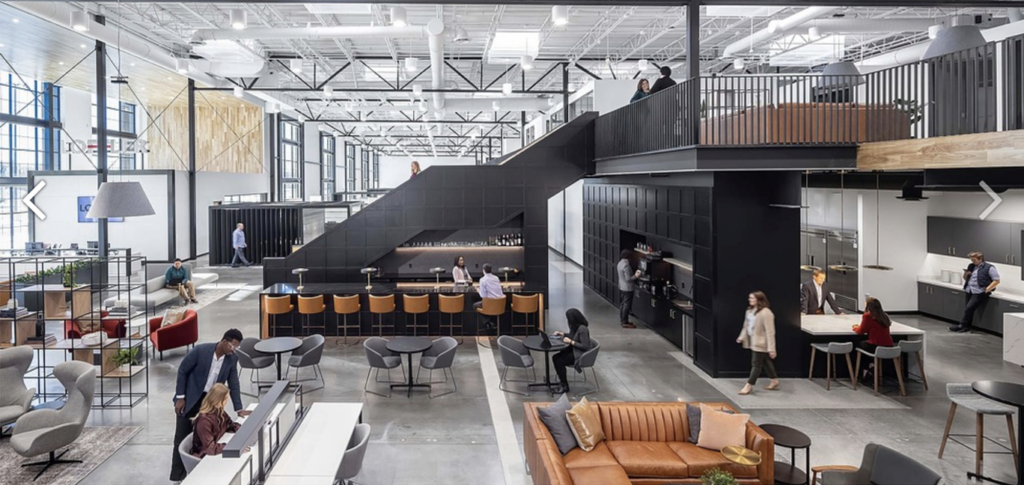
Photo by Brandon Stengel.
Commercial Office Space. Some proposed sites have excellent vehicular access, providing good visibility and accessibility for alternative uses. One good use for sites like these would be commercial office space. The headquarters of Loffler Companies in St. Louis Park, Minnesota, was built in a repurposed big-box store that had closed, and it provides a model for how this could be applied to a warehouse.
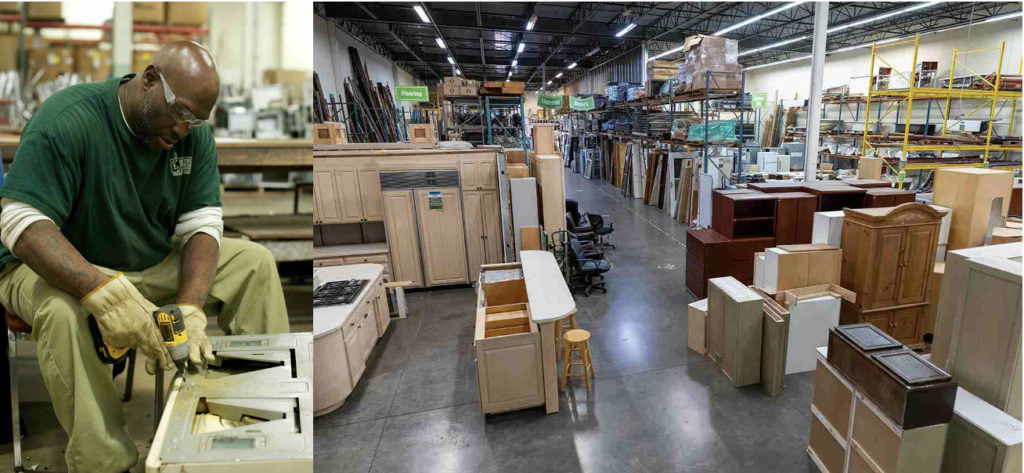
FORMERLY A WAREHOUSE—NOW THE RE-USE WAREHOUSE IN SOUTH MINNEAPOLIS, MINNESOTA
Photos used with permission.
A Hub to Salvage and Upcycle Building Materials. The ReUse Warehouse in Minneapolis, Minnesota, offers a different kind of example: taking a former warehouse and using it as a different kind of warehouse. The ReUse Warehouse provides a place for people to discard building materials they no longer need, making them available to others who can use them. Appliances, cabinets, lumber, and lighting fixtures that might otherwise end up in a landfill are instead resold by a nonprofit organization at an affordable price. Some of the materials are refurbished or repurposed for new uses, and a workforce development model is built around upcycling some of the donated materials, adding value to the products while providing work and training opportunities for community members in the process.
FORMERLY A BIG BOX STORE—NOW A COMMUNITY CHURCH IN OLATHE, MISSOURI
 Photos by Matt Kocourek.
A Community Church. There is a certain poetic justice in repurposing a warehouse or big-box store as a community church. That is what the Heartland Community Church did with a former big-box furniture store in Olathe, Missouri. The goal was to create something nontraditional that met the needs of the contemporary church and its community. The result includes a wide variety of community spaces that the church uses for many different purposes.
These are only a few ideas for possible uses. Many others are possible, and can respond to the specific needs of a region and the warehouse’s location. The architectural publication ArchDaily recently published stunning photographs of 25 repurposed warehouses that offer a broader sense of how innovative and beautiful re-use can be.
Many of the examples above are big-box store conversions rather than the giant warehouses ICE is buying. That means that, in many cases, a single warehouse could be the home for more than one of the above types of examples, or the building could have room for both a repurposed use and surrounding green space.
What Do the Economics Look Like?
Any of the uses outlined above would have a far more positive impact on the local economy than building a facility to hold thousands of people behind bars.
This kind of development will make the nearby area more appealing to other businesses. Retail shops, restaurants, and offices would all be more inclined to locate next to a library or health center than next to an empty warehouse (as most sites are today), with a range of related employment opportunities. By contrast, putting a jail in the area will cast a predictable pall over development in the immediately surrounding area: who wants to set up their business next to a site of imprisonment?
WHERE ICE IS TARGETING WAREHOUSES FOR PURCHASE AND USE AS DETENTION CENTERS
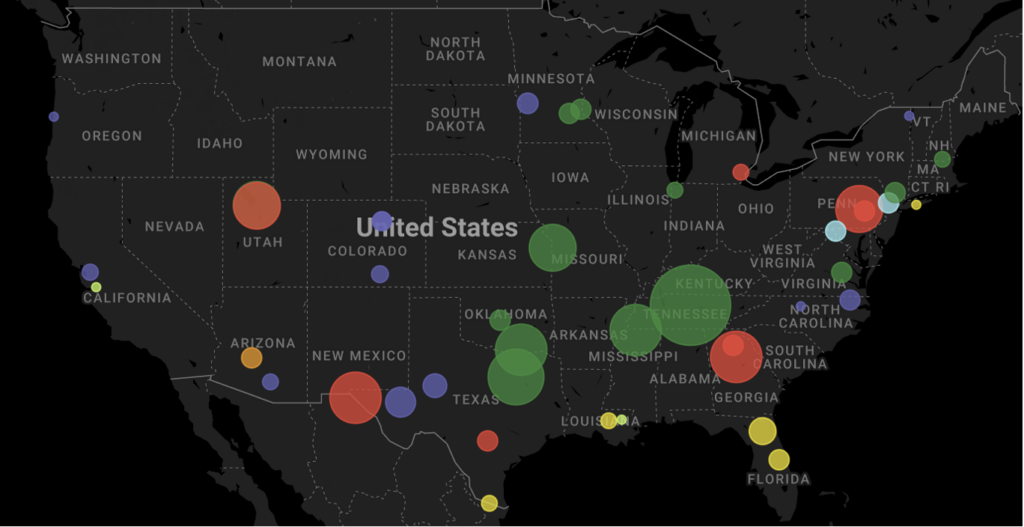
Source: Project Salt Box ICE Warehouse Tracker. Dots represent 11 warehouses purchased (red), five targeted (yellow), one in retrofit (orange), two paused (blue), and 13 canceled (green) as of June 23, 2026.
Creating space for alternative uses will require saying no to ICE, putting a price on the unused warehouses that reflects their true value rather than a highly inflated valuation, and engaging the community in rethinking the options for a site.
As of June 23, 2026, the government has already spent more than $1 billion on 11 warehouse facilities, according to Project Salt Box—a remarkable 134 percent markup over the assessed value of these properties. For the eleven warehouses already bought, including the four still apparently targeted for use as detention centers, imagine what could be achieved if only a small fraction of these federal funds were used to create inspiring community spaces. That could be a smart investment in local economic growth and would make an area increasingly attractive rather than writing it off as a no-go zone for economic development.
Communities with unused warehouses should not feel economically cornered. There are alternative ways to repurpose warehouses that create opportunities for an exciting economic future for the community without putting human lives in jeopardy. Communities should demand no less.