Wisconsin’s health care system is struggling. Rising costs, consolidation and hospital closures, people underinsured or with no coverage at all, and the largest cut to Medicaid in history strain the health care system in all areas of our state. Forty-four of Wisconsin’s 72 counties are designated as a health professional shortage area—meaning there are not enough primary care, dental, and mental health providers to meet demands. These shortfalls impact about 1.7 million1https://ciceroinstitute.org/research/wisconsin-physician-shortage-facts/ Wisconsin residents, particularly in rural and lower-income communities.
Wisconsin’s health care depends on a diverse and growing workforce to meet the needs of patients across the state. Immigrant health care workers are essential to meeting these challenges. They play a critical role across Wisconsin’s health care system by caring for patients, supporting hospitals and clinics, strengthening long-term care services, and helping communities meet growing health care needs. Their contributions are especially important as health care employers across the state continue to report increasing difficulty filling essential positions.
Unfortunately, federal immigration policies and an aggressive strategy of mass arrests of immigrants create new challenges for immigrants and their families. Curtailing eligibility for FoodShare and health care through BadgerCare or the Affordable Care Act, abruptly ending Temporary Protected Status for millions throughout the country, and sharing personal health and financial data long-protected from federal enforcement agencies stoke a climate of fear and uncertainty. Anti-immigrant policies pose risks to immigrant communities and Wisconsin’s health care workforce, but could also impact all Wisconsin families and worsen access to care. Wisconsin’s health care system depends on immigrant workers to help meet the state’s growing health care needs. These policy shifts may also have broader impacts on Wisconsin’s health care system by increasing financial strain on families, raising demand for uncompensated care, and potentially leading to increased provider shortfalls.
This report examines the role immigrants play in Wisconsin’s health care workforce. Using state and national data, it highlights where immigrant health care workers are employed, the occupations they fill, and how their contributions vary across rural, suburban, and urban communities. It also explores why protecting and strengthening this workforce is critical to ensuring that every Wisconsin community has access to high-quality health care. By better understanding the contributions of immigrant health care workers, policymakers, employers, and community leaders can make more informed decisions about building a resilient health care system that is prepared to meet Wisconsin’s current and future needs.
Key Findings
- Immigrants in Wisconsin account for six percent of all health care workers in the state. That is higher than the immigrant share of the population and the same level as the overall labor force.
- Immigrants account for 12 percent of all doctors in Wisconsin, including physicians, surgeons, dentists, and pharmacists. The immigrant share of doctors in the Badger State is more than double the immigrant share of the labor force.
- Immigrant doctors are especially significant in rural areas of Wisconsin. Immigrants account for nine percent of doctors in Wisconsin’s rural counties, playing an important part in providing health care to communities that have a harder time attracting doctors, and where hospitals are often further away and care is more difficult to access.
- Immigrants could play an important part in addressing Wisconsin’s caregiving shortage. Immigrants make up eight percent of personal care workers in the state, which is considerably lower than the 27 percent of those jobs nationally. Paired with improvements in rates and standards, a growing immigrant population could lead to growth in the number of personal care workers, helping to ease Wisconsin’s caregiving crisis.
Immigrants in Wisconsin’s Economy: An Overview
There are 308,000 immigrants living in Wisconsin, accounting for five percent of the state’s population.2Data for this report comes from an IRI analysis of 2024 ACS 5-Year Data. The immigrant share of gross domestic product (GDP) is higher than the immigrant share of the population in Wisconsin, as is also true for the United States as a whole.
Immigrants in Wisconsin Contribute More to GDP than their Share of Population
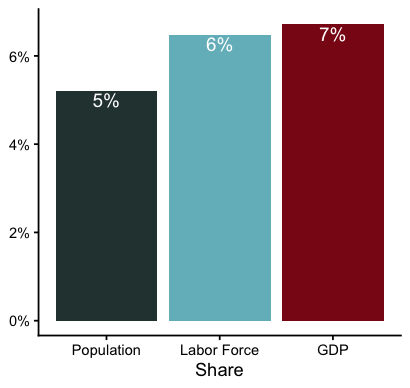
Fig. 1: Showing immigrant share of population, labor force, and state economic output. IRI and Kids Forward analysis of 2024 ACS 5-Year data.
A few key factors explain why. The most salient is that immigrants are more likely to be of working age than their U.S.-born counterparts. That means immigrants are also a bigger share of the labor force (six percent in Wisconsin) than their share of the population. Immigrants also work in a far greater range of jobs than is typically understood,3See, for instance, David Dyssegaard Kallick and Anthony Capote, “Immigrants in the U.S. Economy: Overcoming Hurdles, Yet Still Facing Barriers,” Immigration Research Initiative, January 2023. which results in a robust contribution to overall economic output.
The number and share of immigrants in Wisconsin has also grown over time. In 2000, immigrants made up four percent of the population and an equal share of the labor force, compared to five percent of the population and six percent of the labor force in 2024. That growth in the labor force outpaces population growth is indicative of the fact that immigrants moving to Wisconsin are mostly working-age individuals, looking to contribute to overall growth throughout the state.
Immigrants in Wisconsin work in all sectors of the economy, including 14,000 managers, 13,000 educators (including post-secondary teachers), and 12,000 computer programmers. Immigrants make up disproportionately large shares of several key occupations, such as packaging machine operators (25 percent), software developers (17 percent), and — vital for the purposes of this report — physicians (19 percent).
Immigrants in Health Care Professions
There are 318,000 Wisconsinites working in health care, of whom six percent are immigrants. That is, there are 17,500 immigrants working as doctors, nurses, orderlies, home health aides, and many other occupations to take care of everyone in the state and keep our communities healthy.
Immigrants play a particularly large role as doctors, including physicians, surgeons, dentists and pharmacists. In all, 12 percent of all doctors are immigrants — double the immigrant share of the labor force. When we look specifically at physicians, those doctors who do the lion’s share of day-to-day treatment of patients, immigrants account for 19 percent of all workers in that role.
But that’s not the only area where Wisconsinites rely on immigrants to stay healthy. For example, eight percent of personal care workers — which includes home health aides — are immigrants. Many immigrants also work in care and treatment professions as nurses, nurse practitioners, and acupuncturists. Immigrants make up four percent of all workers in those roles as well as four percent of health care technicians and six percent of health care support roles.
Immigrants Work at Every Level of the Health Care Industry
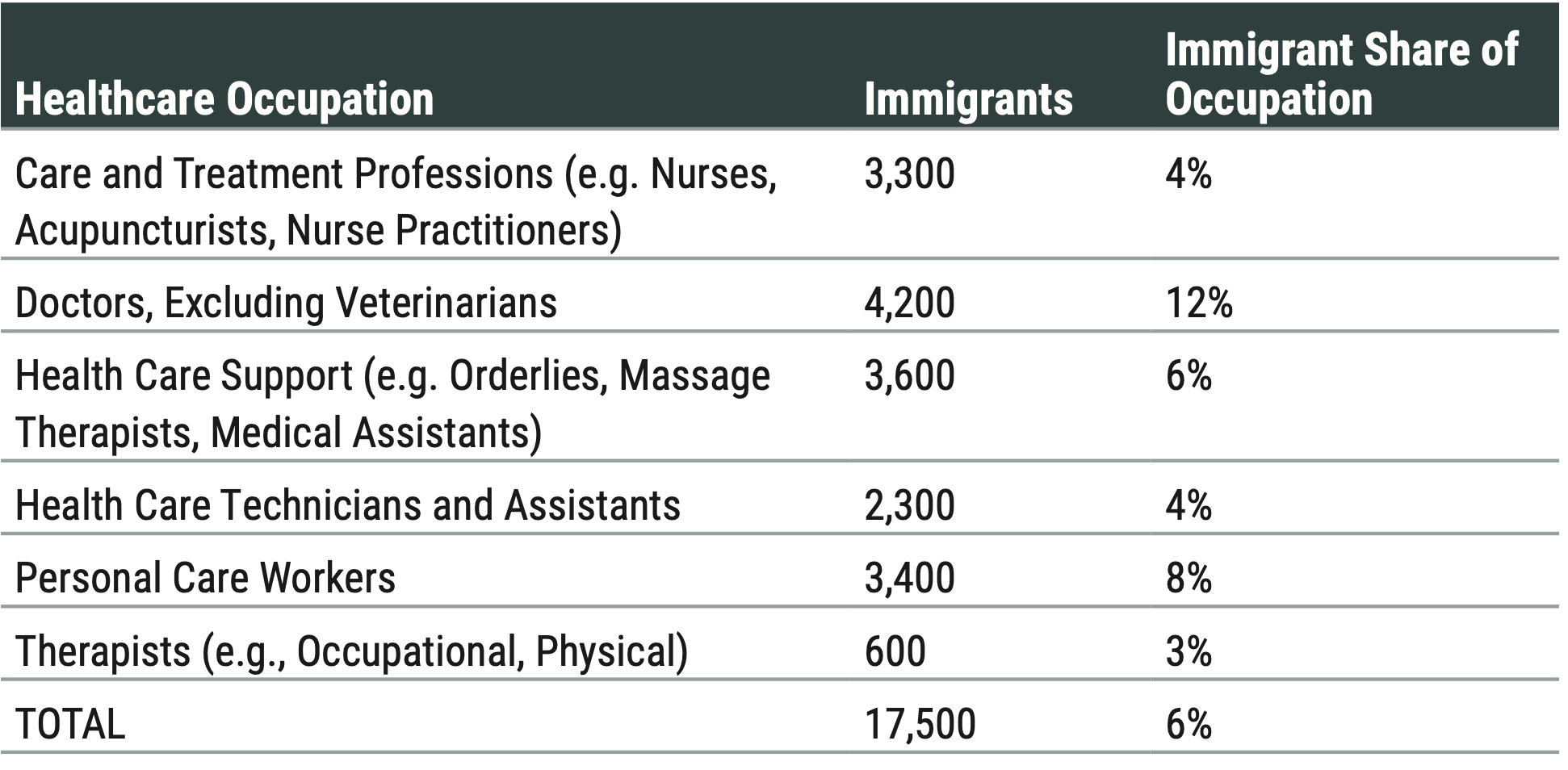
Table 1: Showing the number of immigrants in health care occupations grouped together by type as well as their share of all workers in those jobs. IRI and Kids Forward analysis of 2024 ACS 5-Year data.
Immigrants who support the health care sector in Wisconsin come from all over the world. 13 percent of all foreign-born health care workers in Wisconsin were born in the Philippines, nine percent were born in Mexico, seven percent come from India, and five percent from Thailand.
Immigrants in Health Care Come from All Over the Globe
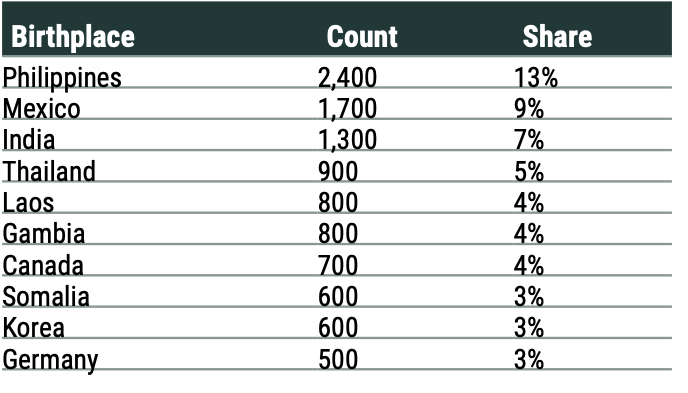
Table 2: Showing the top ten countries of birth for immigrants working health care jobs in Wisconsin. IRI and Kids Forward analysis of 22024 ACS 5-Year data.
Caring for Wisconsinites in all Regions of the State
Immigrants provide vital care to all areas of the Badger State. From high- density urban areas to the most remote farmlands in Wisconsin, immigrants are present as doctors, nurses, and personal care professionals. One key area where Wisconsin’s immigrant workforce in health care makes a substantial difference is in rural communities throughout the state. While many immigrants live and work in urban areas of the state like Milwaukee and Madison, many also live and work in more rural counties like Marathon, Walworth, and Fond du Lac. In rural areas, immigrants make up significant portions of the health care labor force, in places such as Wood, Portage, and Adams counties, where immigrants account for three percent of the population, but six percent of health care workers when looking at all three counties together.
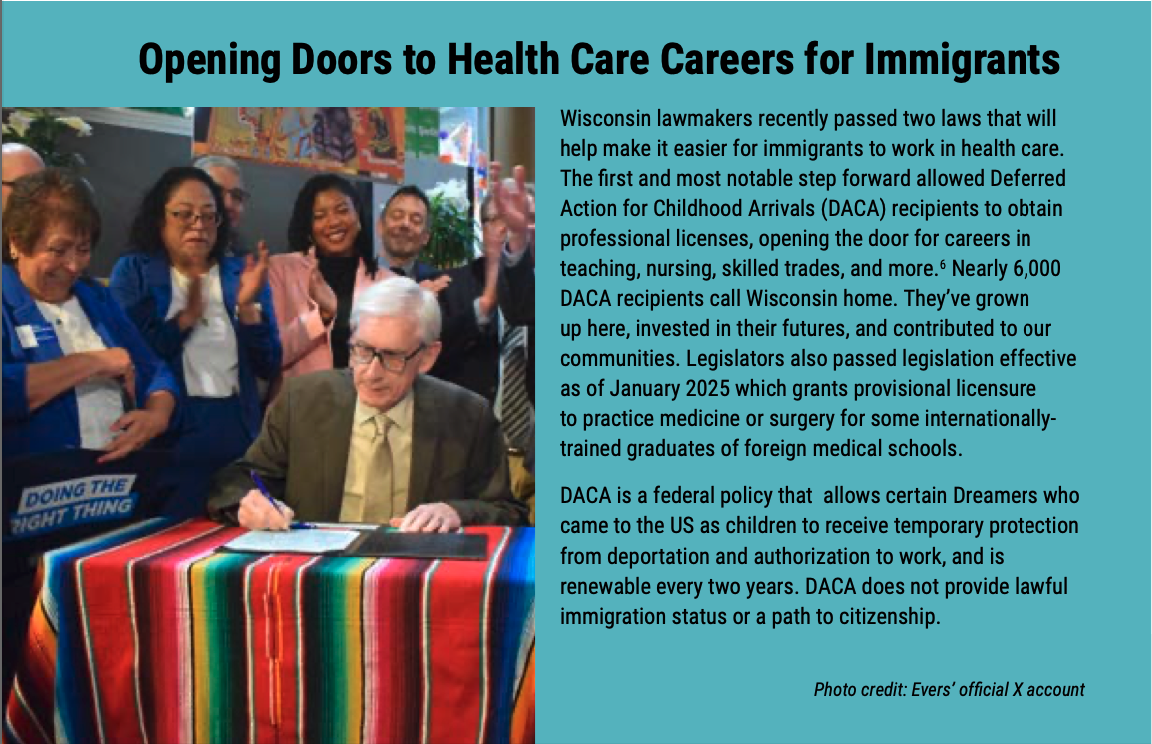
Defining Urban, Rural, & Suburban
For this analysis, we sorted each Public Use Micro-statistical Area (PUMA) in Wisconsin into rural, suburban, or urban categories.4Public Use Micro-Statistical Areas, or PUMAs, are geographical units defined by the U.S. Census Bureau to help researchers identify where people live and work. They are generally larger than census tracts, helping obfuscate the data and protect individual privacy. As a result, however, PUMAs do not always adhere to traditional jurisdictional boundaries like county lines. Some PUMAs might contain parts or all of three different counties in rural areas, while urban areas might typically contain many PUMAs within one county or city. For more information on PUMAs, visit https://www.census.gov/programs- surveys/geography/guidance/geo-areas/pumas.html. We used the population- weighted mean density of each PUMA as a metric for determining whether each PUMA qualified as urban, rural, or suburban.5This method was derived from an analysis of readily available Public Use Micro- Data Samples (PUMS), which included a population-weighted density variable, as well as an analysis by Jonathan Schroeder and José Pacas from 2020.
PUMAs with a population density of 1,000 people per square mile or higher were classified as urban areas. These PUMAs included parts of Milwaukee, Madison, and Green Bay cities as well as some surrounding areas. Areas with population densities between 500 and 999 people per square mile were labeled suburban, while PUMAs with less than 500 people per square mile were called rural areas. Distinguishing urban from suburban and rural areas can be difficult, as suburban areas are often just outside urban ones and the barriers between the two are permeable. Even so, there are other challenges as well, including areas with large swathes of land like parks that might lower the population densityof a PUMA even if there are many people nearby. Using population-weighted densities helps to resolve some of these issues, as does a deep understanding of the geographical areas under investigation. Our analysis provides a fair approximation of the urban/suburban/rural divide in Wisconsin using both of these methods. The map below shows how each PUMA was labeled in Wisconsin.
Distinguishing between Wisconsin’s, Urban, Suburban, and Rural Regions
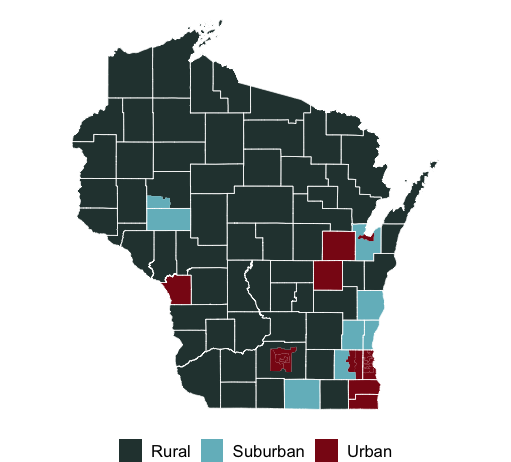
Fig. 2: Showing counties in Wisconsin by weighted population density if the Public Use Mico-statistical Areas (PUMAs) under which they fall. IRI and Kids Forward analysis of 2024 AS 5-Year data.
Immigrants’ Role in Cities and Suburbs
In Wisconsin’s major cities, like Madison, Milwaukee, and Green Bay, immigrants play an important role in the health care industry. In urban areas, immigrants make up 10 percent of the labor force overall, and eight percent of all health care workers. As the map below shows, immigrants make up eight percent of all health care workers in Milwaukee, five percent in Green Bay, and 12 percent in Madison.
Immigrants Make up Eight Percent of Health Care Workers in Wisconsin’s Cities
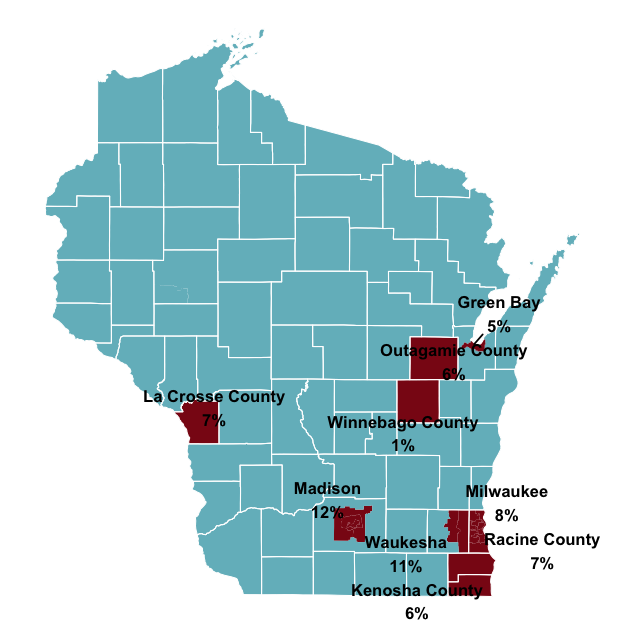
Fig. 3: Showing the immigrant share of heath care workers in Wisconsin’s urban areas. Urban areas shown in red. IRI and Kids Forward analysis of 2024 ACS 5-Year data.
Wisconsin faces persistent shortages of personal care workers, so it is particularly notable that immigrants make up a significant share of the state’s personal care workforce, particularly in urban counties, where immigrants account for 13 percent of personal care workers. As the Governor’s Task Force on Caregiving stated in their final report:
“Wisconsin direct care providers have increasingly relied on workers who come from minority or immigrant communities to fill their positions.”
Wisconsin’s population is aging and the need for caregiving continues to grow, so attracting and retaining immigrant health care workers—coupled with much- needed improvements in wages, working conditions, benefits, and standards, as noted by the Task Force—could help strengthen the state’s personal care workforce and ensure more older adults and people with disabilities can receive care in their homes and communities.
More than 12,000 Immigrants Work Health Care Jobs in Wisconsin’s Urban Regions
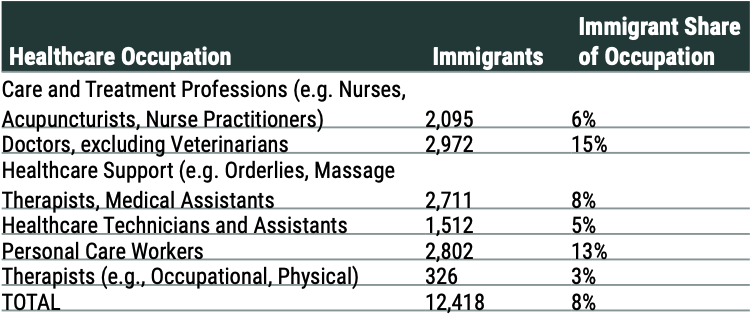
Table 3: Showing the number of immigrants in health care occupations in urban areas of the state as well as their share of all workers in those jobs. Occupations were grouped together by type, see methodology for more details. IRI and Kids Forward analysis of 2024 ACS 5-Year data.
In suburban areas, immigrants make similar, albeit smaller contributions to health care work. In suburban Wisconsin, immigrants account for four percent of the health care workforce, but — as in every area of the state — are much more likely to be doctors. Immigrants make up eight percent of all doctors in suburban regions.
Caring for Suburban Wisconsinites
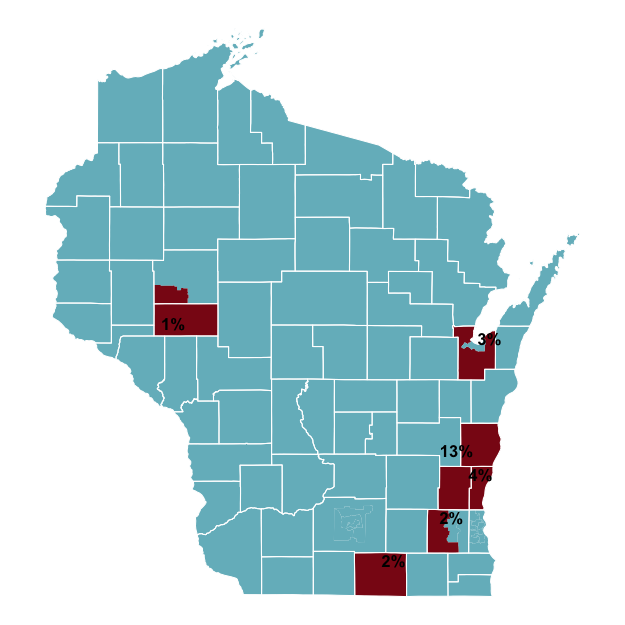
Fig. 4: Showing the immigrant share of health care workers in suburban Public Use Micro-statistical Areas (PUMAs) in Wisconsin. Suburban areas in red. IRI and Kids Forward analysis of 2024 ACS 5-Year data.
Serving Rural Areas as Doctors
In Wisconsin, as around the country, immigrants are more likely to live in cities than in rural areas. Yet, immigrants play a notable role in the health care system of rural areas. Immigrants account for three percent of the population and a proportionate three percent of health care workers in rural Wisconsin.
What really stands out is that immigrants make up nine percent of rural doctors, 2.5 times the immigrant share of the labor force in rural Wisconsin.
Nearly 1 in 10 Doctors in Rural Wisconsin are Immigrants
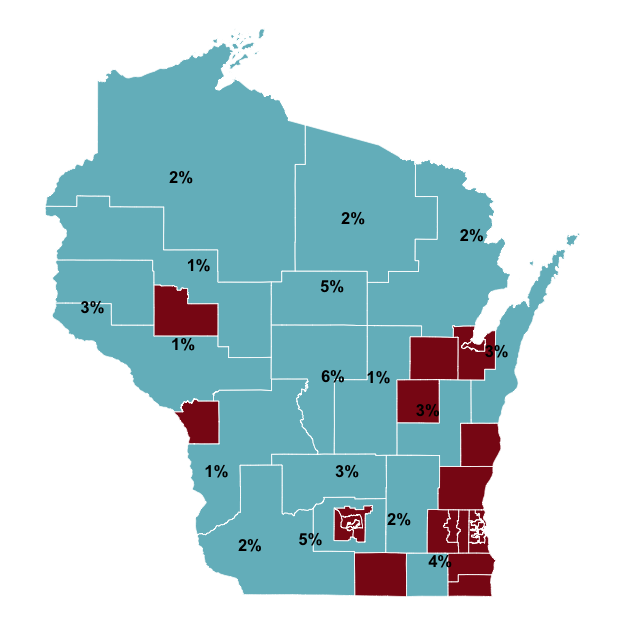
Fig. 5: Showing the immigrant share of heath care workers in rural Public Use Micro-statistical Areas (PUMAs) in Wisconsin. IRI and Kids Forward analysis of 2024 ACS 5-Year data.
Conclusion
In Wisconsin, everyone gains from the participation of immigrants in the state’s health care workforce. This becomes only more evident as the state’s population ages and many health care jobs become hard to fill—from nurses and home health aides in urban areas to doctors in rural areas.
Federal immigration and other policies, such as Medicaid cuts, are currently creating strong headwinds for the health care economy of Wisconsin. Yet, the issues are not all federal. Wisconsin’s state leaders have a choice. Policies that create barriers or uncertainty for immigrant workers risk worsening workforce shortages and limiting access to care for all residents. Wisconsin decision makers should invest in policies that recruit, retain, and support workers, including immigrant workers, and their families, remove unnecessary barriers to employment, and strengthen pathways into health care careers.
Policies that support all health care workers, including immigrants, are policies that strengthen Wisconsin’s health care system, economy, and communities. The future of Wisconsin’s health care system depends on it.
Methodology
Data from this report comes from the 2024 American Community Survey 5-year microdata provided by IPUMS, which includes the survey years 2019
to 2024. Immigrants are defined as is standard in the economic literature
as everyone who is born in a foreign country and lives in the United States, regardless of immigration status. It also includes a small number of people who were born abroad to parents who are U.S. citizens.
In identifying health care workers, we used occupational codes provided by
the U.S. Census Bureau, which distinguishes between “broad” occupational categories like “Service Occupations” or “Computer, Engineering and Science Occupations” and “detailed occupations such as “Social Workers,” “Elementary and Middle School Teachers,” or “Physicians.”
In this analysis, we have defined “healthcare workers” as anyone whose broad occupation falls into the “Healthcare Practitioners and Technical Occupations” category of broad occupations as well as some occupations in the “Service Occupations” category that are directly related to healthcare like home health aides, dental assistants, and pharmacy aides. Veterinarians and vet technicians or assistants were excluded from this definition. That is, a healthcare worker
is anyone whose census-defined occupation includes working to improve the overall health of human beings.
Due to small sample sizes in certain detailed occupations, Tables 1, 3, and 4—which show the number of immigrants in key health care occupations—use a third, modified occupational category created by the research team. This category combines certain occupations within the healthcare category that are similar to one another in specific ways. For example, physicians, surgeons, dentists, and pharmacists were all counted generally as doctors while nurses, registered nurses, and nurse practitioners were all labeled within “Care and Treatment Professions.” For a full list of occupational categories, please see Table 5 below.
| Broad Occupational Category (Census Bureau) | Detailed Occupational Category (Census Bureau) | Hybrid Occupational Category (IRI and KF Wisconsin) |
|---|---|---|
| Healthcare Practitioners and Technical Occupations | Chiropractors | Doctors |
| Healthcare Practitioners and Technical Occupations | Dentists | Doctors |
| Healthcare Practitioners and Technical Occupations | Dietitians and Nutritionists | Doctors |
| Healthcare Practitioners and Technical Occupations | Optometrists | Doctors |
| Healthcare Practitioners and Technical Occupations | Pharmacists | Doctors |
| Healthcare Practitioners and Technical Occupations | Physicians | Doctors |
| Healthcare Practitioners and Technical Occupations | Surgeons | Doctors |
| Healthcare Practitioners and Technical Occupations | Physician Assistants | Doctors |
| Healthcare Practitioners and Technical Occupations | Podiatrists | Doctors |
| Healthcare Practitioners and Technical Occupations | Audiologists | Doctors |
| Healthcare Practitioners and Technical Occupations | Occupational Therapists | Therapists (e.g., Occupational, Physical) |
| Healthcare Practitioners and Technical Occupations | Physical Therapists | Therapists (e.g., Occupational, Physical) |
| Healthcare Practitioners and Technical Occupations | Radiation Therapists | Therapists (e.g., Occupational, Physical) |
| Healthcare Practitioners and Technical Occupations | Recreational Therapists | Therapists (e.g., Occupational, Physical) |
| Healthcare Practitioners and Technical Occupations | Respiratory Therapists | Therapists (e.g., Occupational, Physical) |
| Healthcare Practitioners and Technical Occupations | Speech-Language Pathologists | Therapists (e.g., Occupational, Physical) |
| Healthcare Practitioners and Technical Occupations | Other Therapists | Therapists (e.g., Occupational, Physical) |
| Healthcare Practitioners and Technical Occupations | Registered Nurses | Care and Treatment Professions (e.g. Nurses, Acupuncturists, Nurse Practitioners) |
| Healthcare Practitioners and Technical Occupations | Nurse Anesthetists | Care and Treatment Professions (e.g. Nurses, Acupuncturists, Nurse Practitioners) |
| Healthcare Practitioners and Technical Occupations | Nurse Practitioners | Care and Treatment Professions (e.g. Nurses, Acupuncturists, Nurse Practitioners) |
| Healthcare Practitioners and Technical Occupations | Acupuncturists | Care and Treatment Professions (e.g. Nurses, Acupuncturists, Nurse Practitioners) |
| Healthcare Practitioners and Technical Occupations | Healthcare Diagnosing Or Treating Practitioners, All Other | Care and Treatment Professions (e.g. Nurses, Acupuncturists, Nurse Practitioners) |
| Healthcare Practitioners and Technical Occupations | Clinical Laboratory Technicians | Healthcare Technicians and Assistants |
| Healthcare Practitioners and Technical Occupations | Dental Hygienists | Healthcare Technicians and Assistants |
| Healthcare Practitioners and Technical Occupations | Cardiovascular Technologists and Technicians | Healthcare Technicians and Assistants |
| Healthcare Practitioners and Technical Occupations | Diagnostic Medical Sonographers | Healthcare Technicians and Assistants |
| Healthcare Practitioners and Technical Occupations | Radiologic Technologists and Technicians | Healthcare Technicians and Assistants |
| Healthcare Practitioners and Technical Occupations | Magnetic Resonance Imaging Technologists | Healthcare Technicians and Assistants |
| Healthcare Practitioners and Technical Occupations | Nuclear Medicine Technologists | Healthcare Technicians and Assistants |
| Healthcare Practitioners and Technical Occupations | Emergency Medical Technicians | Healthcare Technicians and Assistants |
| Healthcare Practitioners and Technical Occupations | Paramedics | Healthcare Technicians and Assistants |
| Healthcare Practitioners and Technical Occupations | Pharmacy Technicians | Healthcare Technicians and Assistants |
| Healthcare Practitioners and Technical Occupations | Psychiatric Technicians | Healthcare Technicians and Assistants |
| Healthcare Practitioners and Technical Occupations | Surgical Technologists | Healthcare Technicians and Assistants |
| Healthcare Practitioners and Technical Occupations | Dietetic Technicians | Healthcare Technicians and Assistants |
| Healthcare Practitioners and Technical Occupations | Licensed Practical and Vocational Nurses | Healthcare Technicians and Assistants |
| Healthcare Practitioners and Technical Occupations | Medical Records Specialists | Healthcare Technicians and Assistants |
| Healthcare Practitioners and Technical Occupations | Opticians | Healthcare Technicians and Assistants |
| Healthcare Practitioners and Technical Occupations | Miscellaneous Health Technicians | Healthcare Technicians and Assistants |
| Healthcare Practitioners and Technical Occupations | Other Healthcare Practitioners and Technicians | Healthcare Technicians and Assistants |
| Service Occupations | Home Health Aides | Personal Care Workers |
| Service Occupations | Personal Care Aides | Personal Care Workers |
| Service Occupations | Nursing Assistants | Healthcare Support (e.g. Orderlies, Massage Therapists, Medical Assistants |
| Service Occupations | Orderlies and Psychiatric Aides | Healthcare Support (e.g. Orderlies, Massage Therapists, Medical Assistants |
| Service Occupations | Occupational Therapy Assistants | Healthcare Support (e.g. Orderlies, Massage Therapists, Medical Assistants |
| Service Occupations | Physical Therapist Assistants | Healthcare Support (e.g. Orderlies, Massage Therapists, Medical Assistants |
| Service Occupations | Massage Therapists | Healthcare Support (e.g. Orderlies, Massage Therapists, Medical Assistants |
| Service Occupations | Dental Assistants | Healthcare Support (e.g. Orderlies, Massage Therapists, Medical Assistants |
| Service Occupations | Medical Assistants | Healthcare Support (e.g. Orderlies, Massage Therapists, Medical Assistants |
| Service Occupations | Medical Transcriptionists | Healthcare Support (e.g. Orderlies, Massage Therapists, Medical Assistants |
| Service Occupations | Pharmacy Aides | Healthcare Support (e.g. Orderlies, Massage Therapists, Medical Assistants |
| Service Occupations | Phlebotomists | Healthcare Support (e.g. Orderlies, Massage Therapists, Medical Assistants |
| Service Occupations | Other Healthcare Support Workers | Healthcare Support (e.g. Orderlies, Massage Therapists, Medical Assistants |
- 1https://ciceroinstitute.org/research/wisconsin-physician-shortage-facts/ ↩︎
- 2Data for this report comes from an IRI analysis of 2024 ACS 5-Year Data. ↩︎
- 3See, for instance, David Dyssegaard Kallick and Anthony Capote, “Immigrants in the U.S. Economy: Overcoming Hurdles, Yet Still Facing Barriers,” Immigration Research Initiative, January 2023. ↩︎
- 4Public Use Micro-Statistical Areas, or PUMAs, are geographical units defined by the U.S. Census Bureau to help researchers identify where people live and work. They are generally larger than census tracts, helping obfuscate the data and protect individual privacy. As a result, however, PUMAs do not always adhere to traditional jurisdictional boundaries like county lines. Some PUMAs might contain parts or all of three different counties in rural areas, while urban areas might typically contain many PUMAs within one county or city. For more information on PUMAs, visit https://www.census.gov/programs- surveys/geography/guidance/geo-areas/pumas.html. ↩︎
- 5This method was derived from an analysis of readily available Public Use Micro- Data Samples (PUMS), which included a population-weighted density variable, as well as an analysis by Jonathan Schroeder and José Pacas from 2020. ↩︎