It is increasingly clear that the program of mass deportation being carried out by the current administration is hurting American workers, both immigrants and those born in the United States. Nowhere has this been more stark than in Minnesota. In the peak months of December 2025 through February 2026, the massive surge in ICE arrests ripped people away from their families, their jobs, and their communities. A shocking nearly 4,000 arrests took place in Minnesota over the course of the surge. Arrests reached a peak of 2,524 in January 2026, up from an average of 185 arrests per month for the first 11 months of 2025.
4,000 IMMIGRATION ARRESTS IN MINNESOTA DURING OPERATION METRO SURGE
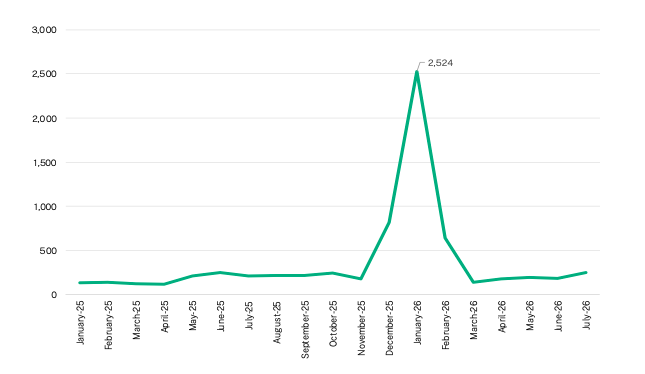
Fig 1. IRI and Minnesota Budget Project analysis of numbers from Deportation Data Project. Over the course of Operation Metro Surge there were 3,986 arrests in Minnesota.
From the earliest preliminary reports to the most recent data analysis, both local and national research show that mass arrests of immigrants have a substantial negative impact on the economy. Adding to this growing body of research, new analysis by the Minnesota Budget Project and the Immigration Research Initiative, based on work by Chloe East and Elizabeth Cox, allows us to estimate that there are now 32,000 fewer jobs in Minnesota than there would have been without the massive increase in ICE arrests.
Operations Metro Surge and PARRIS
From December 2025 to February 2026, more than 3,000 Immigration and Customs Enforcement (ICE) and Customs and Border Patrol (CBP) agents deployed to Minnesota as part of Operations Metro Surge and PARRIS (Post-Admission Refugee Reverification and Integrity Strengthening, which targeted lawfully present refugees), creating a climate of fear and anger as they used overwhelming and intimidating tactics to target people of color and their neighbors across the state. Since the initial surge, media reports have described:
- ICE raids at or near formerly protected sensitive locations like schools, hospitals, childcare centers, churches, and more;
- Numerous instances of racial profiling, in which ICE agents stopped and either attempted to detain or did detain U.S. citizens based solely on the color of their skin—one significant example of this being ICE detentions of Native Americans in Minneapolis;
- Violations of constitutional rights including the arrests of legal observers, unauthorized searches and seizures of the homes of immigrants, extensive and intimidating surveillance of community leaders and protestors; and
- Overuse of chemical agents on crowds, reporters, and in residential neighborhoods, and the use of firearms, culminating in the non-lethal shooting of a resident and the killings of Renee Good and Alex Pretti.
States and cities across the country are experiencing the social, humanitarian, and economic cost of an immigration enforcement regime that has received more than $200 billion from the federal government since the beginning of 2025 to continue to increase arrests and deportations at an unprecedented scale. And, while ICE may have temporarily retreated under the pressure of huge community pushback in Minnesota, arrests being made less publicly continue to rise across the country since February 2026, despite the warnings of advocates that there are shocking human rights violations and the warnings of economists that the result would be negative impacts for both immigrants and U.S.-born workers.
The Domino Effect: Why U.S.-Born Workers Lose Jobs Too
The notion that deporting immigrants causes job losses for U.S.-born workers runs counter to some common narratives about deportation. It is, however, very much in line with the economic research on mass deportations.
- Immigrant and U.S.-born workers often hold complementary roles and when one group disappears, work dries up for the other.
- When immigrant workers are removed from the labor market through detention and deportation, it shrinks the workforce and shrinks the consumer base as many immigrants and their families no longer shop at businesses or eat at restaurants.
- Exacerbating this cycle of job loss is a chilling effect. Some immigrants, including some with authorization to work, such as those with green cards and those who are U.S. citizens, stay away from work and other activities in order to protect themselves from reckless ICE actions that could result in their arrest and detention, despite their legal status.
- Workers are also worse off when ICE targeting makes them more vulnerable to exploitation. Studies have shown that ICE targeting results in an increased number of on-the-job accidents and minimum wage violations for all workers, as workers feel less empowered to report workplace safety and labor law concerns.
The economic impact of the torrent of harmful changes in immigration enforcement is increasingly evident. Because of immigration and other federal policies, the overall U.S. labor market in 2025 was weaker than in 2024, with higher unemployment, slower hiring, and stagnating wages. Numerous news articles report that employers are having a hard time finding workers due to heightened ICE activity, with no indication of gains in either wages or employment of U.S.-born workers. And recent analyses have found sizable declines in foot traffic and consumer spending following ICE raids during the current administration, which could reduce demand for workers.
Nationally, a September 2026 report from Brookings Institution recently updated a prior study reaching a parallel conclusion: increased immigration arrests depress local employment, the employment shortfall significantly exceeds the number of arrests, and the effects are long-lasting.
In Minnesota specifically, North Star Policy Action estimated very early on the dollar impact of Operation Metro Surge, the employment decline, the high unemployment rate after the surge, job losses in February, and job losses in the leisure and hospitality sector.
The research is clear—increased immigration enforcement comes at an economic cost to everyone, including U.S.-born workers.
Estimating the Decline in Employment from Metro Surge & PARRIS
In order to illustrate what the impacts of surges in immigration enforcement could be at the state level, researchers Chloe East and Elizabeth Cox from the University of Colorado, in partnership with IRI, modeled a scenario in which one percent of the immigrants most at risk, defined as immigrant men with a high school education or less, are arrested. (See the methodology section for details.)
This model uses data from January to November 2025—before Operation Metro Surge was in effect in Minnesota. It predicts that a dramatic statewide surge in enforcement that resulted in the arrest of one percent of the most at-risk population would cause a direct removal of 700 immigrant men from their jobs and an additional drop in employment of another 1,300 immigrant men. In this scenario specifically, the predicted job loss for U.S.-born men in Minnesota is 4,500. One percent was used as a simple example.
Our analysis quantifies the impact on both immigrants and U.S.-born workers in Minnesota based on the actual arrest data during Operation Metro Surge and PARRIS. During the surge in Minnesota, nearly 4,000 immigrants, 86 percent of them male, were arrested between December 2025 and February 2026. More than 2,000 of those arrests resulted in deportation.
After scaling the one percent model to actual arrest numbers, we find a stark decline in employment, with the majority of the job loss falling on U.S.-born workers. According to our model, the level of employment for immigrants who were not among those arrested is 7,000 lower than it would have been without the surge, and the employment level for U.S.-born workers is 25,000 lower than it would have been. Overall employment in the state is 32,000 below what it would have been without the surge.
JOB REDUCTIONS IN MINNESOTA DUE TO METRO SURGE & PARRIS
![]()
![]()
![]()
![]()
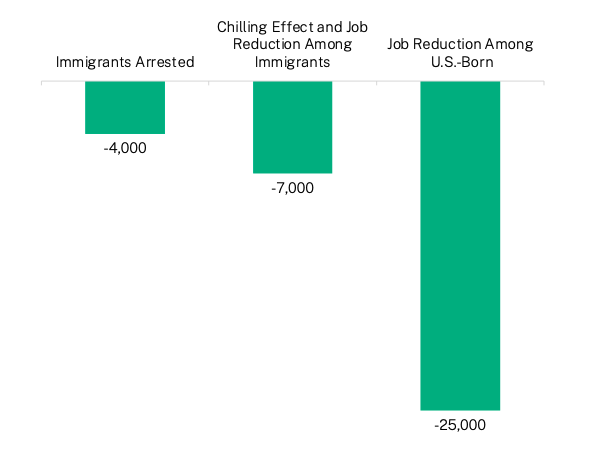
Fig 2. IRI and Minnesota Budget Project analysis based on ICE Arrests Result in a Decline in Employment: State-Level Projections.
A Shockwave that Hurt Minnesota
Mass deportation is not doing what many common narratives promised. Instead, it is hurting our economy and causing irreparable social harm. Deporting immigrants causes a large decline in employment relative to what it would have been, without improving wages for those workers who remain employed.
Immigrants, including those without documentation, are an important part of Minnesota’s economy. There are 495,000 immigrants in Minnesota, including 200,000 who are non-citizens, and among those an estimated 129,000 who are unauthorized.1For the number of immigrants, non-citizen immigrants, and estimate of immigrants who are undocumented, see the Immigration Research Initiative fact sheet, “50 States: Immigrants by Number and Share.” Number of immigrants and non-citizen immigrants are an IRI analysis of the 2024 ACS. Number of immigrants who are undocumented is estimated by the Center for Migration Studies based on the 2024 ACS. The fact sheet gives parallel estimates from the Pew Research Center (2023 ACS) and from the Migration Policy Institute (2019 5-year data). And immigrants, including those who are undocumented, pay taxes. In 2022, people who are undocumented paid nearly $222 million in Minnesota state and local taxes, according to estimates by the Institute on Taxation and Economic Policy. Detention and deportation of these workers would dramatically decrease affordability and availability of important goods and services, as well as jobs for both immigrants and U.S.-born workers.
During this period of increased immigration arrests, the immigrants most vulnerable to deportation continue to be those who are undocumented, but the impact does not end there. People who have temporary visas may have seen them terminated or unrenewed. People with temporary protected status, asylum seekers, DACA recipients, and many others are also in a precarious position. Operations Metro Surge and PARRIS were proof that legal status no longer provides the same sort of protection that it used to.
Minnesotans know firsthand that enforcement strategies that were common during Operations Metro Surge and PARRIS disrupted not just the lives of our immigrant neighbors, but workplaces, schools, and communities across the state. The surge contributed to a long list of social and economic ills, which the state of Minnesota is currently in the process of documenting through the Minnesota Truth Council.
If you or someone you know has a story of the impact of the surge, economic or otherwise, please consider participating in the Minnesota Truth Council by sharing your story with the Advocates for Human Rights.
Methodology
Using employment statistics from across the country in 2025, a national study conducted by economists Chloe East and Elizabeth Cox measured the impact of increases in ICE arrests in the period prior to Operation Metro Surge and PARRIS. Their findings were first issued in a Working Paper of the National Bureau of Economic Research, and then published as an Immigration Research Initiative report that summarized the national findings and looked at state-level implications.
The national study compares areas and periods where there was a steep increase in immigration arrests to areas where there was not. A regression analysis that accounts for a range of other factors finds that areas with steep increases in arrests saw a cascade of job loss.
Immigrants who were arrested lost their jobs directly. Other immigrants, including many who have work authorization, experienced a chilling effect and stayed home or left the country. And, as the consumer base shrank and co-workers who support the daily operation of local businesses were arrested, U.S.-born workers also lost their jobs.
The study shows that for every 1,000 ICE arrests of immigrant men, there is a 2.5 percent decline in employment for immigrant men in the most-at-risk group—a higher level than found in past studies, likely due to the increased chilling effect of the seemingly indiscriminate nature of current ICE activity. (The most at risk group is defined below.) This analysis focuses largely on men because over 90 percent of those arrested by ICE in the second Trump administration, and before, were male. In Minnesota, during the months of December 2025 through February 2026, 86 percent of the 4,000 people arrested were male.
As predicted by previous studies—but contrary to promises from the Trump administration—the study also shows a decline in employment for U.S.-born men in areas of enhanced ICE activity. In particular, the study finds that for every 1,000 immigrants arrested, there is a statistically significant 0.54 percent decline in the employment of U.S.-born men in the area.
To calculate the impact on Minnesota, we applied these rates to the estimates of Minnesota’s workforce as defined in the original study. These data show Minnesota has about 1.17 million employed U.S.-born men ages 20 to 64 and about 71,500 employed immigrant men ages 20 to 64 with a high school education or less, the group most likely to be at risk of being targeted by ICE. For every 1,000 arrests, this implies about 6,300 fewer U.S.-born men working and about 1,800 fewer immigrant men working.
Finally, we scaled these figures to the roughly 4,000 arrests made during Operation Metro Surge and PARRIS. This is a conservative estimate of the impact, since it is possible that the relationship is not linear as arrests increase, and the impact on both immigrant and U.S. born workers could be even higher.
- 1For the number of immigrants, non-citizen immigrants, and estimate of immigrants who are undocumented, see the Immigration Research Initiative fact sheet, “50 States: Immigrants by Number and Share.” Number of immigrants and non-citizen immigrants are an IRI analysis of the 2024 ACS. Number of immigrants who are undocumented is estimated by the Center for Migration Studies based on the 2024 ACS. The fact sheet gives parallel estimates from the Pew Research Center (2023 ACS) and from the Migration Policy Institute (2019 5-year data). ↩︎